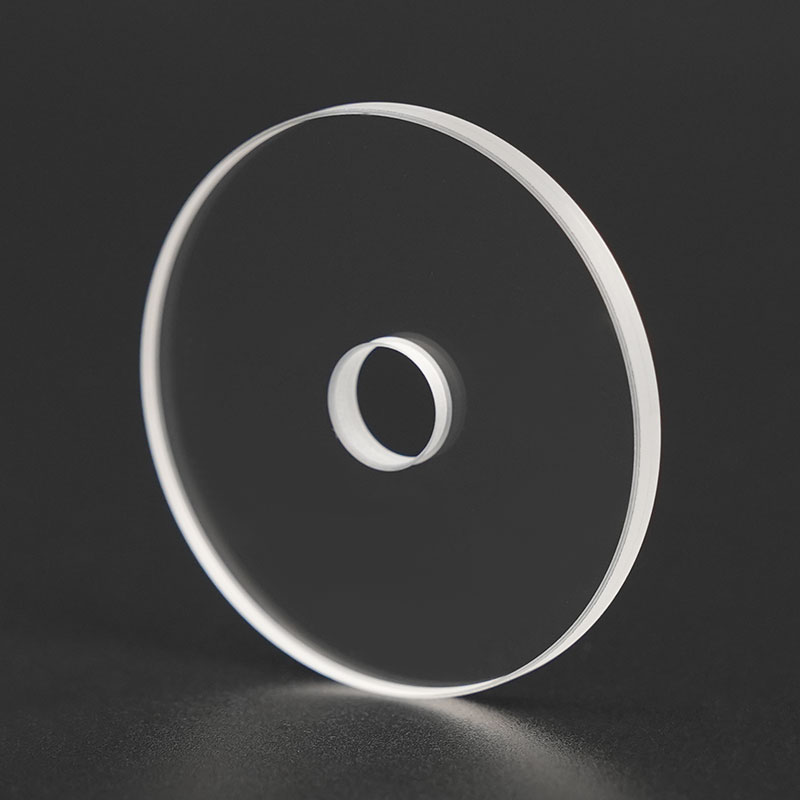
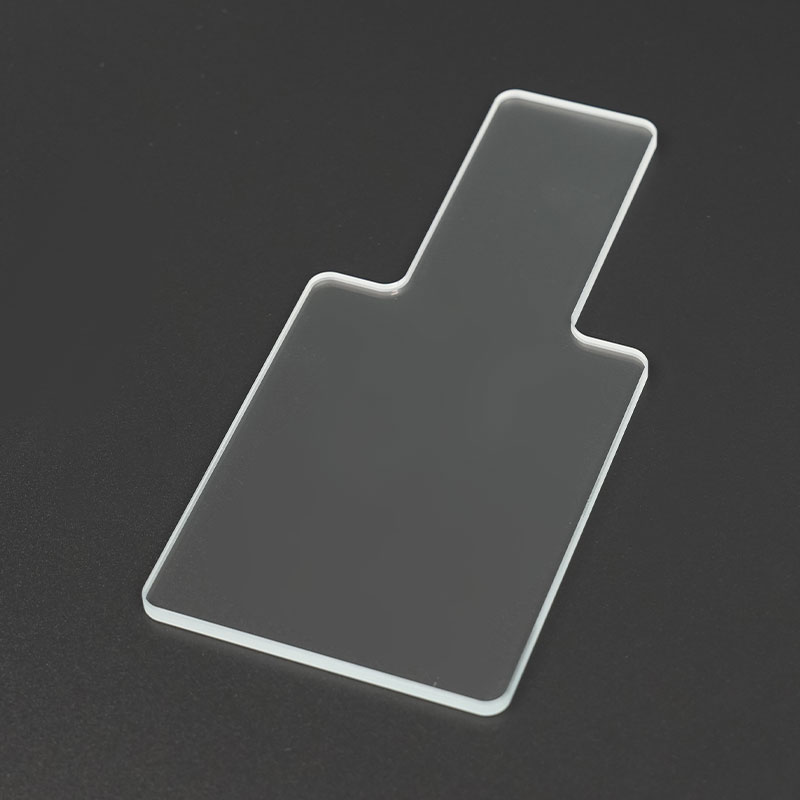
The visible light band ranges from 400 to 700 nanometers, which are the colors that the human eye can distinguish. The infrared glass in Xiamen is 532nm for green and 633nm for red, with a difference of 100nm between the two. Lenses used within this range have very high requirements for the peak value of the coating center, and the offset is usually controlled within 5nm. The shorter the wavelength, the higher the requirement for the position accuracy of the central peak. For example, for ultraviolet 355nm and 266nm, the offset is less than 5nm. This is a very demanding test for coating equipment and processes. The company is a professional manufacturer of far-infrared optical glass.
Infrared glass requires that the glass itself has a very high transmittance for infrared light. Infrared glass is divided into monocrystalline and polycrystalline types. In power switch cabinets, relatively speaking, infrared optical films are all long-wave um level, such as CO2 laser being 10.6um (10,600 nm), and infrared thermal imaging films being 3-5um and 8-14um. Their films are also very thick. It is usually at the um level, so the position accuracy of the central peak will not be very high. The same peak drift of 0.1 μ m (100nm) is equivalent to red turning green in the visible light field, and the film layer is definitely unqualified. However, when the same situation occurs in the infrared light field, it is equivalent to 10.6 μ m to 10.5 μ m, with the maximum transmittance remaining unchanged (usually a flat curve), only the appearance color changes. Therefore, in infrared film systems, due to the thick film layer, the cumulative thickness difference may increase, causing color variations. However, when applied to infrared light, this does not affect its usage. Usually, this color difference occurs in different batches of coatings, and the color is almost the same in the same batch of coatings! If customers have requirements for the consistency of color in infrared film layers of different batches, it will be a challenge for manufacturers. This requires additional control precision, which invisibly increases the cost of the product and leads to a higher selling price. This pursuit of external color does not help the actual performance at all.




 English
 Español