Home · News · Industry News · Sustainable Packaging Solutions for Businesses: Materials, Costs & Checklist
Sustainable Packaging Solutions for Businesses: Materials, Costs & Checklist
Author: AdminDate: Aug 20,2026
Every packaging buyer knows the squeeze: customers ask for sustainable packaging, the finance team watches the unit cost, and the production line cannot afford downtime. Meanwhile the regulatory floor keeps rising. The EU Packaging and Packaging Waste Regulation, in force since February 2025, requires all packaging placed on the EU market to be recyclable by 2030, and similar rules are taking shape in the UK, Canada and parts of Asia. The conclusion is straightforward: sustainable packaging is no longer a differentiator — it is the new specification baseline. This guide explains what the term actually means, compares materials that work in practice, shows what the switch costs, and helps you evaluate suppliers before you commit.
Industry frameworks, including the design guidance published by the Sustainable Packaging Coalition, describe sustainable packaging as packaging that is beneficial and safe through its lifecycle, meets market criteria for performance and cost, and is sourced, manufactured, transported and recovered using practices that minimize environmental impact. In practical terms, four categories dominate most specifications. Each has a different end-of-life story, and the differences directly affect the claims you can put on your pack.
Four common sustainable packaging categories and the practical differences buyers should verify.
Type
End of life
Best suited for
Watch out for
Recyclable
Recovered through standard recycling streams
Dry foods, frozen goods, e-commerce
Multilayer laminates with aluminum are often not recyclable
Biodegradable
Breaks down under natural conditions; timing varies
Short-life products, agricultural applications
“Biodegradable” alone does not guarantee safe or fast breakdown
Compostable (certified)
Breaks down in industrial composting per EN 13432 / ASTM D6400
Fresh produce, single-use food service
Rarely accepted in home compost; needs dedicated collection
Reusable
Returned, refilled or reused multiple times
B2B distribution, refill systems
Requires reverse logistics and cleaning systems
Behind these categories, four design principles do most of the environmental work:
Reduce material at the source through lighter, stronger structures.
Design for the recycling streams that actually exist in your target markets.
Use renewable or recycled content wherever performance allows.
Optimize the supply chain: a smaller cube and lighter weight cut transport emissions.
Flexible packaging is central to this agenda because replacing rigid cans, jars and cartons with pouches typically cuts packaging weight by a third or more. Lifecycle comparisons of rigid versus flexible formats consistently show the same result: lighter packaging means less material, lower freight cost and fewer transport emissions, without sacrificing product protection.
Materials compared: what to specify
There is no single “greenest” material. The right choice depends on the product, its required shelf life, the recycling infrastructure in your target markets, and the filling equipment you run. These are the four material groups that dominate sustainable packaging specifications today.
Recyclable mono-material films
Mono-material PE or PP structures keep the pouch compatible with film recycling streams where they exist. They suit snacks, dry foods, frozen products and household goods. The trade-off is barrier performance: without aluminum or EVOH layers, oxygen and moisture ingress is higher, so shelf life must be confirmed with real test data.
Compostable and bio-based films
Certified compostable films, such as PLA-based structures certified to EN 13432 or ASTM D6400, break down in industrial composting. They are a good match for short-shelf-life products like fresh-cut produce. The catch is disposal infrastructure: without access to industrial compost facilities, the material ends up wherever the rest of the waste goes.
Paper and kraft
Paper packaging uses renewable fiber and is widely recyclable. Kraft paper bags with a thin PE or biodegradable lining are common in retail and e-commerce. Paper alone is a poor barrier against moisture and oxygen, so most food applications need a lining that is compatible with the paper recycling stream.
Recycled content
Films with post-consumer recycled resin reduce virgin plastic demand. Recycled-content films with 30–50% PCR are increasingly available; verify that the recycled layer is positioned away from food contact unless the full structure meets food-contact regulations.
Chart 1. Indicative performance profiles based on typical supplier datasheets; ratings are directional, not laboratory values.
Formats that work on real production lines
Material choice matters, but format selection decides whether the pack runs efficiently, stands out on shelf, and survives the supply chain. It also helps to know the differences between pouch types before you choose — this guide to flexible food packaging compares the most common formats and their typical uses.
Stand-up pouches with eco structures
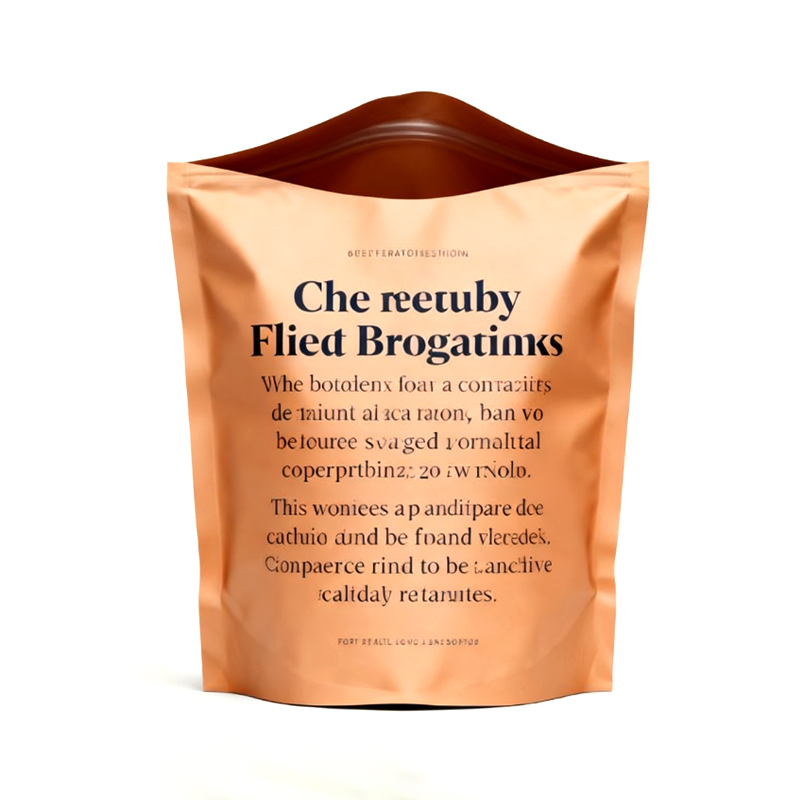
Stand-up pouches are the workhorse of sustainable flexible packaging. They stand on a gusset base, maximize shelf presence, and can be produced in mono-material, recycled-content or certified compostable structures. For brands that want a clear end-of-life story without changing pouch ergonomics, the biodegradable stand-up pouch is a proven place to start.
Chart 2. Key structural elements of a stand-up pouch: top seal, reclosable zipper, front print panel, side gusset and sealed bottom.
Rollstock film for automated lines
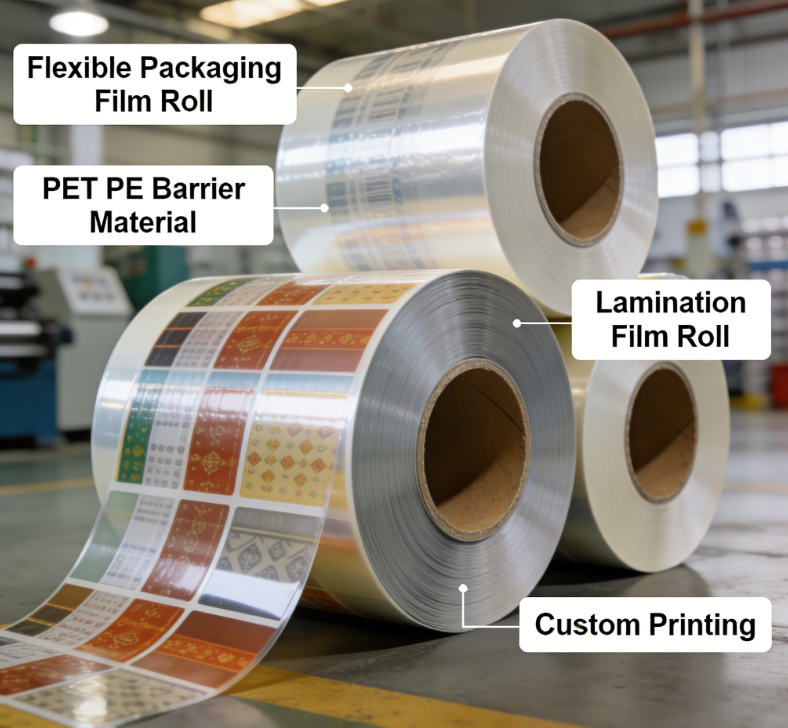
For high-speed filling, rollstock film remains the most efficient format. A high-barrier cast composite film can replace aluminum-based structures for oxygen-sensitive food, while mono-material PE or PP rollstock keeps the pack fully recyclable. Because food waste carries a far larger environmental footprint than packaging, a longer shelf life often beats a slightly lighter film.
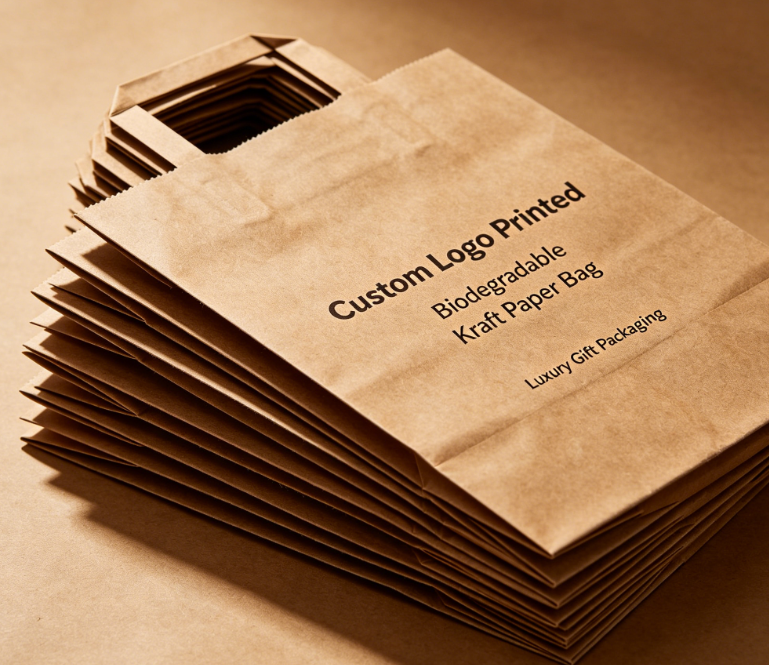
Kraft paper bags are replacing single-use plastic in retail, food service and online orders. Options range from punched hand-held gift bags to fully printed bags with a biodegradable lining for food contact. They read as natural to customers and fit standard curbside paper recycling when the lining is compatible. A growing number of brands start with custom kraft paper bags, including biodegradable shopping paper bags, to make the switch visible at the point of sale.
Cost is the first question in any buying meeting. The honest answer is that sustainable formats are not uniformly more expensive. A mono-material recyclable pouch can be within a few percent of a conventional laminate once the structure is optimized. Compostable films carry the largest premium, recycled-content films sit in the middle, and paper formats vary widely by size and print. Compare total cost per pack delivered, not material price alone.
Chart 3. Illustrative relative unit cost versus a standard PE pouch (index = 100); actual quotes vary with volume, size, print and structure.
Market signals worth presenting internally
The market is moving in one direction. Market analysts commonly estimate that the global sustainable packaging market will grow from roughly US$300 billion today to around US$480 billion by 2030, a compound annual growth rate of 6–7%. Consumer pressure reinforces the trend: multiple surveys published between 2023 and 2025 report that between half and three-quarters of consumers say sustainable packaging influences their purchase decisions, with the highest sensitivity in the Asia-Pacific region.
Chart 4. Illustrative trajectory of the global sustainable packaging market in US$ billion, 2023–2030, based on commonly cited industry estimates.
Chart 5. Share of consumers who say sustainable packaging influences their purchase decision — indicative ranges based on publicly reported 2023–2025 consumer surveys.
Regulation adds a cost dimension as well. Under extended producer responsibility schemes, packaging fees are increasingly modulated by recyclability, which means non-recyclable packaging becomes more expensive year after year. Budgeting for the switch now is cheaper than paying the penalty later.
How to evaluate a sustainable packaging supplier
Not every supplier who claims to make “eco” packaging can prove it. Run every candidate through this checklist before you commit:
Independent certification — ISO 9001 for quality, ISO 14001 for environmental management, and BRC for food-safety compliance.
Testable claims — compostability certificates (EN 13432, ASTM D6400, BPI or OK Compost), recycled-content declarations, and oxygen and moisture transmission data.
Structural honesty — confirm that zippers, spouts, valves and inks do not make the pack non-recyclable even when the main film is recyclable.
Production transparency — ask how the factory manages solvents, waste and energy, and visit the site or request a video audit.
Logistics footprint — a supplier close to major export ports shortens lead times and reduces transport emissions.
A good benchmark for this standard is Hangzhou Zhiwei Packaging. Founded in 1989 and operating from Longgang, the “China Printing City”, the company holds ISO 9001, ISO 14001 and BRC certification, supplies flexible packaging to food, beverage, pet-food and retail brands, and has built a dedicated line of eco-friendly products. You can see what certified production lines look like on the factory page, and once your specification is ready, request samples and a quotation to validate performance before you commit.
A practical roadmap for switching
A phased approach keeps risk low and results measurable.
Audit your current packaging: list every SKU, its material structure, weight, shelf-life requirement and current end-of-life status.
Prioritize the SKUs with the largest volume or the worst environmental profile — that is where change delivers the fastest benefit.
Define specifications: barrier targets (OTR and WVTR), filling temperature, sealing window, drop-test requirements and branding constraints.
Shortlist at least three suppliers that provide data sheets, certificates and samples, including one with documented eco-product lines.
Run a pilot on your actual line and measure speed, seal integrity, leaker rate and cost per unit against the current pack.
Scale up, monitor field performance, and update customers with the new environmental credentials.
Frequently asked questions about sustainable packaging
Short, practical answers to the questions buyers ask most often.
Q1. What is the most sustainable packaging material?
There is no single best material. The most sustainable option protects the product, fits existing recycling or composting systems, and uses the least material. For many dry goods that means a recyclable mono-material film with recycled content; for fresh short-shelf-life items, a certified compostable pouch; for retail and e-commerce, a kraft paper bag with a compatible lining.
Q2. Is biodegradable packaging the same as compostable packaging?
No. Biodegradable means a material breaks down over time under certain conditions, with no defined timeframe or residue standard. Compostable packaging certified to EN 13432 or ASTM D6400 breaks down within a fixed period in industrial composting and leaves no toxic residue. Always ask for certification, not just a label.
Q3. How much more does sustainable packaging cost?
Based on typical OEM quotations, certified compostable films run roughly 20–40% above conventional poly films. Mono-material recyclable films are often within 5–15% once optimized, and recycled-content films add 5–20%. Lighter weight, lower shipping cost and modulated EPR fees offset part of the premium, so compare total cost per pack rather than material price alone.
Q4. Can sustainable packaging protect food as well as conventional packaging?
Yes, when the structure matches the product. High-barrier recyclable films protect oxygen- and moisture-sensitive foods, and certified compostable films suit short-life products. Specify oxygen and water vapor transmission rates and the shelf-life target in writing, then validate with a pilot run before switching.
Q5. Are recyclable pouches with zippers, spouts or valves available?
They are available, but the details matter. A recyclable mono-material film can become non-recyclable if the zipper, spout or valve is made from a different resin, or if the adhesive interferes with sorting. Ask the supplier for the complete structure and confirm which recycling stream accepts the finished pack.
Q6. How do I choose a sustainable packaging supplier?
Prioritize suppliers with ISO 14001, ISO 9001 and, for food, BRC certification. Ask for independent test reports, material traceability and references from brands in your category. Compare minimum order quantities, lead times and logistics, and always run a pilot batch before scaling up.



 English
 Español