Home · News · Industry News · How Selective Absorption Glass Filters Improve Optical Systems?
How Selective Absorption Glass Filters Improve Optical Systems?
Author: AdminDate: May 26,2026
Selective absorption glass filters improve optical systems by blocking specific wavelength ranges — UV, infrared, or targeted visible bands — while transmitting only the wavelengths required for a given application. The result is a dramatic reduction in stray light, improved signal-to-noise ratio, greater image contrast, and protection of sensitive detectors and human eyes from harmful radiation. Unlike interference coatings that depend on angle of incidence, selective absorption glass filters achieve their spectral properties through the intrinsic chemistry of the glass matrix itself — making their performance stable, durable, and independent of optical geometry.
From machine vision optical filter systems in industrial inspection lines to scientific optical filters used in fluorescence microscopy, UV blocking glass filters protecting sensors in outdoor instruments, and IR cut optical filters enabling accurate color reproduction in digital imaging — selective absorption glass filters are foundational components across every precision optical discipline. This article explains the physics behind how they work, the specific improvements they deliver in different systems, and the application-specific considerations that guide filter selection.
The term "selective absorption" describes a filter mechanism fundamentally different from reflection-based or interference-based filtering. In a selective absorption glass filter, specific ions or molecular species dissolved or suspended within the glass matrix absorb photons of particular energies through electronic transitions. When a photon's energy matches the transition energy of an absorbing species in the glass, it is absorbed and converted to heat rather than transmitted. Photons outside this energy range pass through with minimal attenuation.
Common absorbing agents include transition metal ions (cobalt, nickel, copper, iron, chromium), rare earth ions (neodymium, praseodymium, erbium), and semiconductor nanoparticles (cadmium sulfide, cadmium selenide). Each produces a characteristic absorption band at specific wavelengths determined by the electronic structure of the ion or compound. By combining multiple absorbing species at controlled concentrations, manufacturers precisely shape transmission curves — creating sharp cut-on or cut-off slopes, narrow bandpass windows, or broadband blocking with defined residual transmission.
A key advantage of absorption-based filtering is that blocked light is dissipated as heat within the glass, not reflected back into the optical system. Reflected light from interference filters can create ghost images and secondary illumination problems. Absorption eliminates this, making selective absorption optical glass filters especially valuable in high-precision imaging, spectroscopic, and laser-based systems where stray light control is critical.
Typical Transmission Profiles: UV Blocking vs IR Cut vs Bandpass Optical Glass Filters (%)
Representative transmission curves illustrate how three types of selective absorption optical glass filters partition the spectrum. The UV blocking filter has near-zero transmission below 380 nm and high transmission across the visible and near-infrared range. The IR cut optical filter does the opposite — transmitting visible wavelengths while sharply attenuating above 700 nm to prevent infrared contamination of imaging sensors. The narrow bandpass filter isolates a single spectral band around 550 nm, which is the approach used in fluorescence, laser line, and spectroscopic applications requiring single-wavelength isolation.
UV Blocking Glass Filters: Protecting Sensors and Enhancing Image Clarity
Ultraviolet radiation spans wavelengths from approximately 10 nm to 400 nm and is invisible to human vision but highly active in photochemical and photodegradative processes. In optical systems, UV radiation creates several problems: it causes fluorescence in optical cements, lens coatings, and polymer components; it induces false signals in UV-sensitive detectors intended for visible-range imaging; and in high-intensity applications, it damages sensitive optical surfaces and biological specimens.
A UV blocking glass filter absorbs UV radiation through iron or cerium oxide doping in the glass matrix, providing absorption onset typically at 300–400 nm with a sharp transition to high visible transmission. In digital camera systems and machine vision optical filter setups, UV-absorbing glass placed in the optical path eliminates the image haze, reduced contrast, and false color that UV-sensitive silicon sensors would otherwise produce. Studies show that removing UV contribution below 380 nm can improve outdoor photographic contrast ratios by 15–25% in high-UV environments such as high-altitude and equatorial locations.
In biochemical analysis instruments — spectrophotometers, fluorometers, and plate readers — UV blocking glass filters isolate excitation and emission wavelengths with precision, preventing cross-contamination between excitation light and the fluorescence signal being measured. The stability of the absorption-based UV cut is also critical: unlike coated interference filters, UV blocking glass filters do not experience UV-induced coating degradation, maintaining their spectral performance throughout the instrument's service life.
IR Cut and Infrared Absorption Filters: Enabling Accurate Color in Imaging Systems
Silicon image sensors — used in virtually all digital cameras, machine vision systems, and scientific cameras — are sensitive to wavelengths from approximately 300 nm to 1100 nm. The human eye, by contrast, perceives only 380–700 nm. Without an infrared cut filter, silicon sensors capture substantial near-infrared energy that the eye would never see, causing severe color inaccuracies: reds shift magenta, greens appear yellow, and skin tones become washed out.
An IR cut optical filter — also called an infrared absorption filter or hot mirror glass — corrects this by absorbing or reflecting near-infrared wavelengths above approximately 680–720 nm while maintaining high transmission across the visible range. Absorption-type infrared cut filters achieve this through iron oxide or other transition metal doping that creates strong NIR absorption bands. Properly specified IR cut filters reduce silicon sensor infrared sensitivity by over 99% in the 800–1000 nm range, eliminating color error at its source rather than attempting correction in software.
In machine vision optical filter applications — component inspection, print quality control, food sorting, pharmaceutical verification — IR cut filters ensure that illumination sources with strong NIR output (LEDs, halogen, daylight) do not create spectral artifacts that confuse automated classification algorithms. The consistency and wavelength stability of glass-based infrared absorption filters across temperature cycling is particularly valued in industrial environments where camera systems operate across wide ambient temperature ranges.
Signal-to-Noise Ratio Improvement with Selective Absorption Filters (% Gain vs. Unfiltered)
Signal-to-noise ratio improvements across five representative optical system applications when selective absorption glass filters are added to an unfiltered baseline. Laser line filters used in spectroscopy achieve the highest improvement because they isolate an extremely narrow wavelength band, eliminating virtually all broadband background noise. Fluorescence imaging with bandpass filters shows similarly high gains because the filter separates excitation light from the much weaker emission signal — a separation that defines whether fluorescence detection is even possible. Even the more modest UV blocking improvement of 48% represents a meaningful quality gain for outdoor imaging systems.
Colored Glass Filters and Bandpass Applications in Scientific Optical Systems
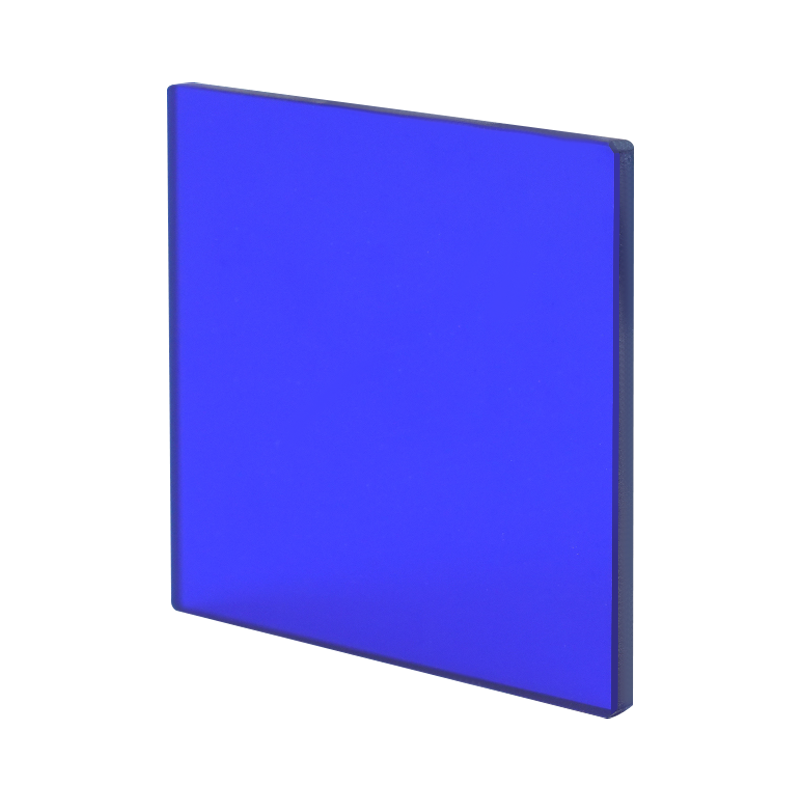
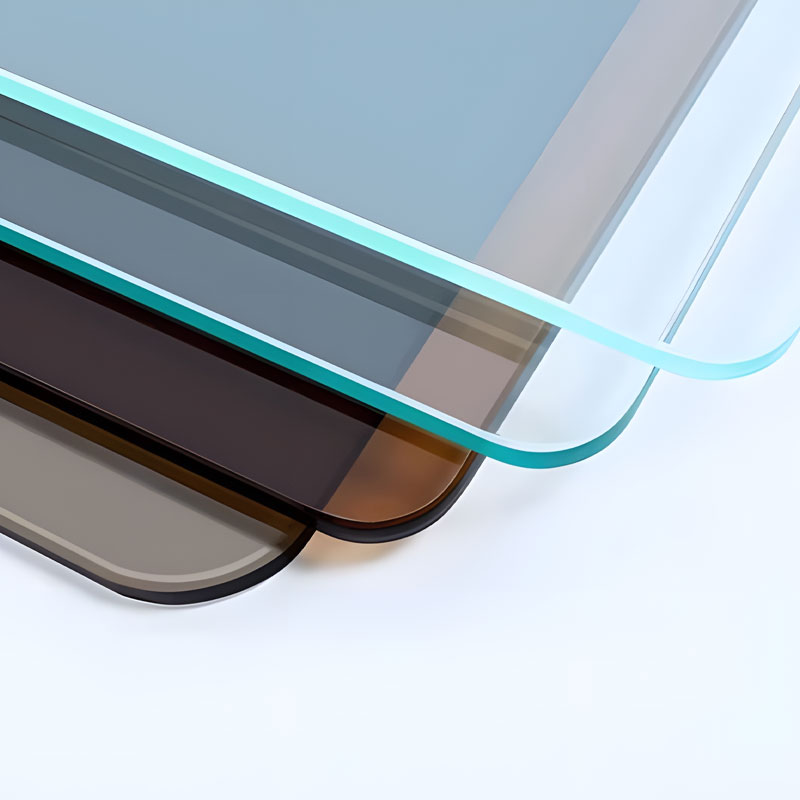
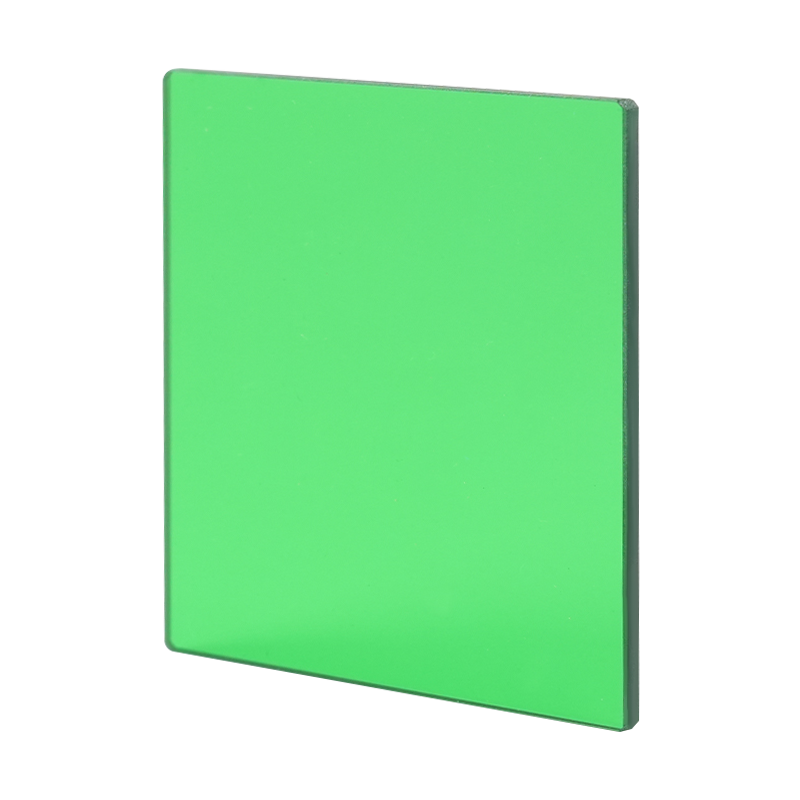
Colored glass filters — the broadest category of selective absorption optical glass filters — absorb across defined spectral regions, transmitting only specific color bands. They range from sharp-cut longpass and shortpass filters (which transmit all wavelengths above or below a defined cut point) to broad bandpass filters centered on specific color regions. Unlike narrow interference-based bandpass filters, colored glass bandpass filters typically have wider transmission bands (50–200 nm FWHM) and are used in applications requiring color separation rather than single-wavelength isolation.
In scientific optical filters for analytical instruments, colored glass filters provide the excitation wavelength selection and emission isolation required for absorbance measurements in spectrophotometers, colorimeters, and flame photometers. A blue glass filter centered around 440 nm, for example, selects the optimal measurement wavelength for protein assays measured by the Bradford method. A red longpass filter blocking below 600 nm isolates the hemoglobin absorption band in clinical hematology instruments.
Colored glass filters offer a critical advantage in high-throughput or continuous-operation instruments: they do not require alignment and show no degradation from repeated thermal cycling that can delaminate interference filter coatings. In instruments that cycle between room temperature and elevated operating temperatures hundreds of thousands of times over their service lives, the intrinsic stability of absorption-based colored glass filters is a significant reliability advantage.
Common selective absorption optical glass filter types, their spectral characteristics, and primary application fields in scientific and industrial optical systems.
Filter Type
Transmission Band
Blocking Region
Key Applications
UV Blocking Glass Filter
380–2500 nm
<380 nm (UV)
Photography, Sensors, Instruments
IR Absorption Filter
380–700 nm
>700 nm (NIR/IR)
Digital Cameras, Machine Vision
Blue Bandpass Filter
400–500 nm
UV and Green–IR
Fluorescence, Spectrophotometry
Green Bandpass Filter
500–580 nm
UV, Blue, Red–IR
Clinical Analysis, NDVI Imaging
Red Longpass Filter
>600 nm
UV and Visible <600nm
Laser Protection, Hematology
Neutral Density Filter
Broadband (attenuated)
None (uniform attenuation)
Intensity Control, Calibration
Laser Protection Filters: Eye and Sensor Safety in High-Power Optical Systems
Laser protection filters represent one of the most safety-critical categories of selective absorption glass filters. In laser-based research, industrial processing, medical laser systems, and military rangefinding equipment, stray laser radiation poses severe risk to eyes and sensitive detectors. A laser protection filter provides high optical density (OD) — meaning very high absorbance — at the specific laser wavelength while maintaining adequate transmission at other wavelengths for viewing or detection purposes.
Glass-based laser protection filters absorb laser wavelengths through resonant electronic transitions in dopant ions matched to the laser's output wavelength. Common laser lines requiring protection include 532 nm (green Nd:YAG), 694 nm (ruby), 1064 nm (Nd:YAG fundamental), and 10,600 nm (CO2). Glass-based laser protection filters are preferred over polymer alternatives in high-power applications because glass does not degrade under sustained laser exposure — a critical safety property since a filter that degrades under irradiation provides diminishing protection over time.
In detector protection applications — protecting CCD, CMOS, or photomultiplier tube detectors from accidental direct laser exposure — laser protection filters are integrated directly into the optical path. The glass filter's absorption-based mechanism ensures that high-intensity laser pulses do not cause the reflective glare that interference-based notch filters can produce, keeping the protected detector safe even from specular laser reflections.
Required Optical Density (OD) at Blocking Wavelength by Application Type
Optical density (OD) requirements vary dramatically across filter applications. OD is a logarithmic measure — OD 1 means 10% transmission, OD 2 means 1%, OD 4 means 0.01%, and OD 7 means just 0.00001% transmission. Laser protection filters demand the highest OD values because even extremely small fractions of transmitted laser power can cause irreversible eye or sensor damage. Scientific spectroscopy requires high OD at blocking wavelengths to prevent intense excitation light from masking the weak signals being measured. Lower OD values are sufficient for imaging applications where residual stray light is a quality issue rather than a safety-critical one.
Machine vision systems — cameras and processing algorithms used for automated quality control, measurement, and sorting in manufacturing — place unique demands on optical filters. Unlike human vision, machine vision algorithms are highly sensitive to illumination consistency and spectral contamination. A feature that appears clearly distinguishable to a human eye under variable lighting may be undetectable to an algorithm if spectral conditions are inconsistent.
Machine vision optical filters solve this by defining and controlling the spectral environment: eliminating ambient light contamination, restricting the sensor to a specific illumination wavelength band, and ensuring that material spectral signatures are consistently rendered regardless of ambient conditions. A machine vision line inspecting food products under LED illumination, for example, uses a bandpass filter matched to the LED emission peak — ensuring the camera only sees light from the controlled illumination source, not variable ambient fluorescent or daylight contamination.
In high-speed inspection applications, glass-based machine vision optical filters are preferred because their spectral properties do not drift under the thermal cycling produced by high-power LED illumination arrays. Polymer interference filters used in some lower-cost systems can shift their cut-on wavelengths by 5–10 nm per 10°C temperature change — enough to cause systematic detection errors in precision sorting or measurement applications. Glass absorption filters maintain stable spectral characteristics from -40°C to +80°C without performance drift.
Performance Radar: Selective Absorption Glass vs. Thin-Film Interference Filters
The radar comparison reveals the complementary strengths of selective absorption glass filters versus thin-film interference filters across six performance dimensions. Glass absorption filters dominate in thermal stability, long-term durability, stray light control, and angle-of-incidence independence — properties that make them the preferred choice in industrial, medical, and scientific instruments operating under demanding conditions. Interference filters lead in achievable peak transmission and the ability to define very narrow custom bandwidths, making them valuable where maximum throughput at a precise wavelength is the primary requirement. Many advanced optical systems use both filter types in combination to capture the advantages of each.
Key Specifications When Selecting Optical Glass Filters
Selecting the correct selective absorption glass filter requires careful evaluation of several interdependent optical and physical specifications. A filter that meets transmission requirements but does not match the physical, thermal, or surface quality requirements of the application will underperform regardless of its spectral properties.
Transmission and Optical Density Specifications
The transmission curve defines what percentage of incident light passes through the filter at each wavelength. For a UV blocking glass filter, the key specifications are the cut-on wavelength (where transmission rises from near-zero to usable levels), the slope of the transition (how sharply the filter transitions from blocking to transmitting), and the peak transmission in the pass band. For an infrared absorption filter, the cut-off wavelength and the blocking depth (optical density) in the infrared are critical. These specifications must be matched to the light source spectrum and detector sensitivity range of the specific optical system.
Surface Quality and Homogeneity
In imaging and measurement applications, the optical homogeneity of the glass filter — its uniformity of refractive index throughout the glass volume — determines whether the filter introduces wavefront distortion. High-quality scientific optical filters are specified to scratch-dig surface quality standards (typically 60-40 or better for precision applications) and bubble and inclusion grades that ensure the filter does not introduce internal scattering. For filters placed near focal planes or in collimated beam paths, surface quality of 40-20 or finer may be required to avoid resolution degradation.
Operating Temperature Range and Coating Compatibility
If the filter requires an anti-reflection (AR) coating to maximize transmission in the pass band, the coating process and materials must be compatible with the glass composition. Selective absorption glasses containing certain dopants can have thermal expansion coefficients that differ significantly from standard optical glass, and AR coatings deposited on poorly matched substrates will delaminate under thermal cycling. Reputable optical glass filter manufacturers specify both the operating temperature range of the filter and the AR coating compatibility for each glass type.
Cut-on / cut-off wavelength: The wavelength at which transmission crosses 50% — defines the filter's spectral position.
Slope steepness: How quickly transmission transitions from blocking to passing — expressed as the wavelength range between 1% and 90% transmission points.
Optical density in blocking region: How thoroughly unwanted wavelengths are rejected — higher OD means better blocking but may require thicker glass.
Peak transmission: The maximum transmission in the pass band — critical for low-light applications; AR coatings can boost peak transmission by 4–8%.
Physical dimensions and parallelism tolerance: Filter thickness, diameter, and wedge angle tolerances affect transmitted wavefront quality.
Temperature coefficient of transmission: How much the spectral position shifts per degree Celsius — important for thermally unstable environments.
Industry Applications: Where Selective Absorption Glass Filters Make the Difference
The range of industries depending on selective absorption optical glass filters extends from consumer electronics through to defense, reflecting the universal importance of spectral control in precision optical systems.
Market Adoption Rate of Optical Glass Filters by Industry Sector (%)
Medical instruments show the highest optical glass filter adoption rate at 88%, reflecting the stringent spectral control requirements of clinical diagnostic equipment including spectrophotometers, flow cytometers, pulse oximeters, and endoscopic imaging systems. Machine vision and industrial inspection follows closely, driven by the widespread deployment of automated quality control systems across electronics, pharmaceutical, and food manufacturing industries. Consumer imaging shows lower adoption because many UV and IR filtering functions are integrated directly into sensor packages, though dedicated glass filters remain prevalent in professional imaging equipment and interchangeable lens systems.
Nantong Xiangyang Optical Element Co., Ltd., founded in 1996, is a professional OEM and ODM manufacturer of selective absorption glass filters in China. The company's Optical Components Production Division specializes in colored optical glass and colorless optical glass processing, offering over a hundred types of optical glass filter products spanning the UV, visible, near-infrared, and infrared spectral regions. Their products serve fields including optical instruments, medical instruments, biochemical analysis, analytical instruments, electronics, aviation, military, and scientific research institutions — demonstrating the breadth of industries that depend on high-quality selective absorption optical glass filters from a reliable, experienced manufacturer.
Frequently Asked Questions
Q1: What is the difference between a selective absorption glass filter and an interference filter?
A selective absorption glass filter blocks wavelengths by absorbing them within the glass material itself — converting unwanted photon energy to heat. An interference filter uses thin-film coatings to reflect unwanted wavelengths out of the optical path. The key practical differences are: absorption filters are angle-independent (performance does not change with beam angle), more thermally stable, and eliminate reflected stray light; interference filters can achieve narrower bandwidths and higher peak transmission but shift spectrally with temperature and angle of incidence.
Q2: Why do digital cameras need an IR cut optical filter?
Silicon image sensors are sensitive to near-infrared light (700–1100 nm) that the human eye cannot see. Without an infrared cut filter, the sensor records this invisible IR energy alongside visible light, causing color inaccuracies — particularly red and green channel contamination that makes skin tones appear unnatural and colors shift toward magenta or yellow. An IR cut optical filter placed in the optical path absorbs NIR wavelengths before they reach the sensor, ensuring the captured image matches human visual perception.
Q3: How do I choose the correct UV blocking glass filter for my application?
The key specification is the cut-on wavelength — the point where the filter transitions from UV blocking to visible transmission. For general photography and sensor protection, a cut-on at 380–400 nm is standard. For applications where any UV transmission would cause problems (e.g., UV-sensitive biological samples or UV-curable materials), a cut-on at 400–420 nm provides extra margin. Also consider the filter's blocking depth below the cut-on wavelength — scientific applications typically require OD 3 or higher, while consumer photographic filters with OD 1–2 are adequate for general imaging.
Q4: Are selective absorption glass filters suitable for high-temperature environments?
Colored optical glass filters are generally far more temperature-stable than polymer or epoxy-based alternatives. Most selective absorption glass filters maintain stable spectral properties from -40°C to +80°C or beyond, though the specific range depends on the glass composition and any applied coatings. For very high-temperature applications (above 150°C), the glass substrate itself remains stable but anti-reflection coatings may require special high-temperature formulations. Always check the manufacturer's specified operating temperature range, which should be verified during instrument qualification testing.
Q5: What optical density do I need for a laser protection filter?
The required optical density depends on the laser power, wavelength, and whether the application is eye protection or detector protection. For eye protection against class 3B or class 4 lasers, optical densities of OD 4 to OD 7 or higher are typically required, and the filter must comply with relevant laser safety standards (IEC 60825, EN 207, EN 208). For detector protection in lower-power systems, OD 3–4 is often sufficient. Always consult the relevant safety standards and perform a laser hazard analysis specific to your system rather than selecting OD values generically.
Q6: Can selective absorption glass filters be customized for specific wavelength requirements?
Yes. Professional optical glass filter manufacturers like Nantong Xiangyang Optical Element Co., Ltd. offer OEM and ODM services for custom filter specifications. Glass composition can be selected from standard catalog types, or special melt compositions can be developed for specific cut-on/cut-off wavelengths not achievable with standard glasses. Physical dimensions, thickness, shape, and surface finish are all customizable. For high-volume production, custom glass compositions are cost-effective; for low-volume precision requirements, selecting from the wide range of existing glass types with custom cutting and polishing is the typical approach.




 English
 Español