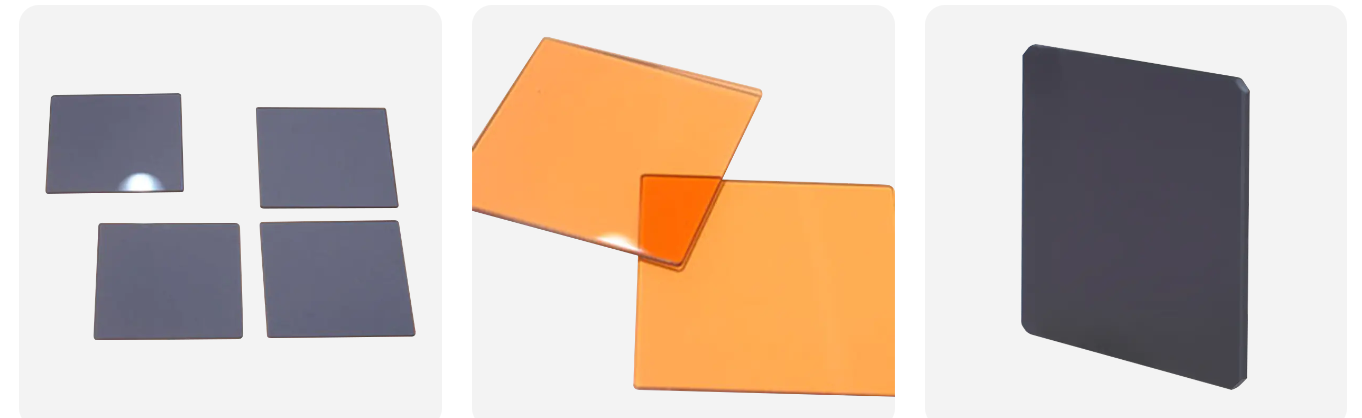
For most instruments, lighting fixtures and sensor housings that need to hold their color performance for years without recalibration, selective absorption glass filters generally outperform thin film coating filters in angle stability, thermal resilience and mechanical durability. A selective absorption glass filter works through the bulk material itself, so the filtering effect does not depend heavily on the angle at which light strikes the surface and does not wear away the way a deposited film can over time. Optical coating filters still hold an edge when a design calls for an extremely narrow passband, a steep cutoff slope, or a wavelength combination that plain colored glass cannot reach on its own. The sections below walk through the physical reasoning, the spectral behavior and the practical selection criteria behind that answer, including several comparison charts and a short buyer checklist near the end.
A selective absorption glass filter is a piece of optical glass formulated to remove a specific wavelength band from a light beam while letting the surrounding bands pass through with minimal loss. Manufacturers reach this effect by melting metal ions or fine colloidal particles directly into the glass batch, then adjusting the glass composition and any surface treatment so the finished piece absorbs a chosen part of the visible or near infrared spectrum. The physical basis sits at the electron level: when photons of a particular energy strike the doped glass, that energy matches the gap between electron states in the added ions, so those photons are absorbed rather than transmitted. Every other wavelength that does not match this energy gap continues through the glass largely unaffected, which is what gives this type of visible light absorption glass filter its clean, repeatable spectral profile.
Common Doping Approaches Used In Production Glass
Three doping families cover most commercial demand today, each aimed at a different part of the spectrum.
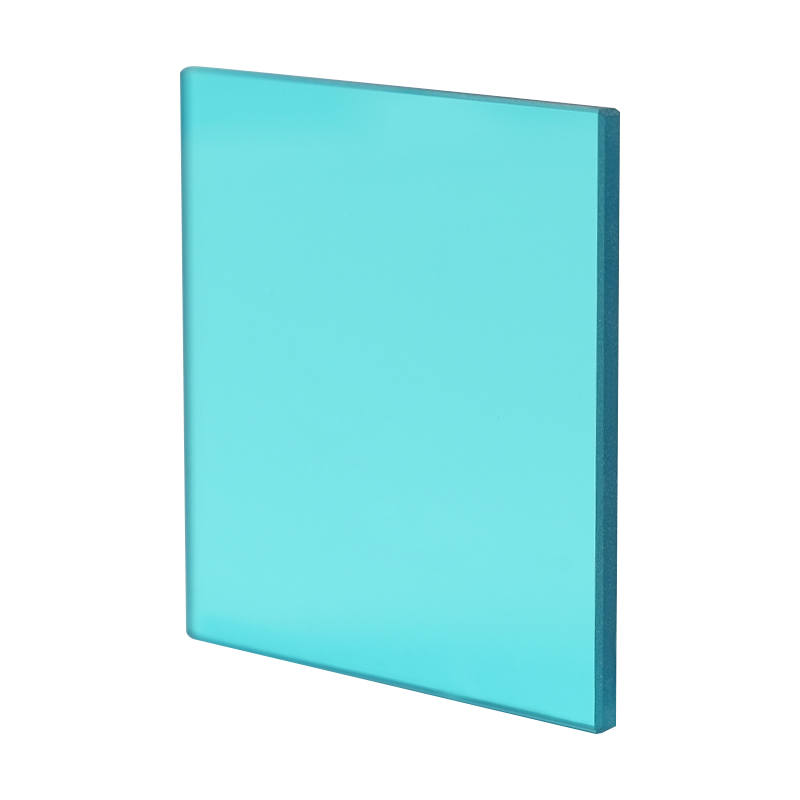
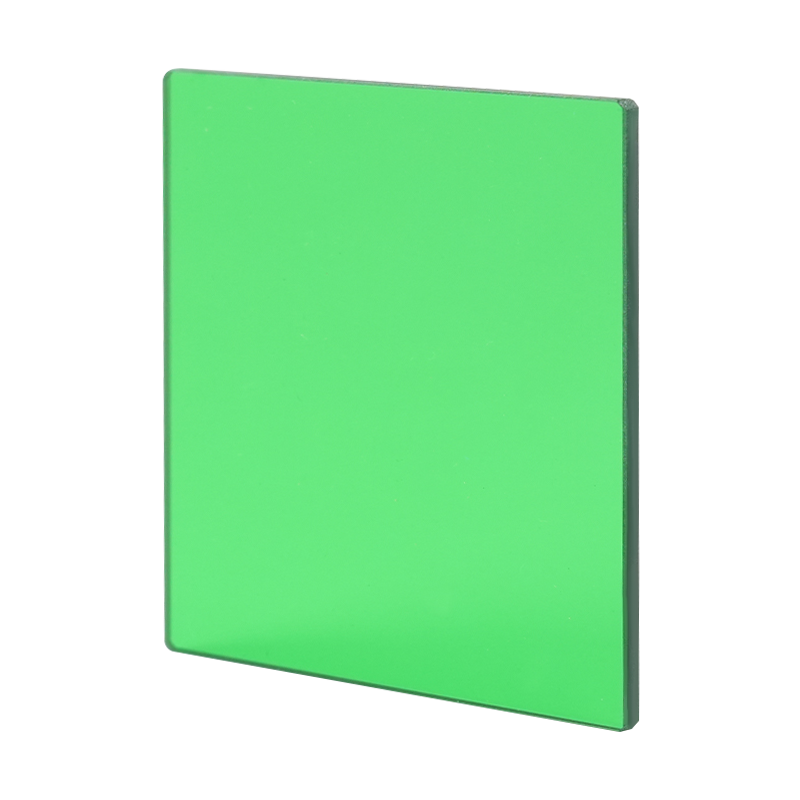
Transition metal ions such as chromium and copper produce a green selective absorption glass filter with a transmission peak roughly between 500 and 560 nanometers, while pulling down blue violet and red light.
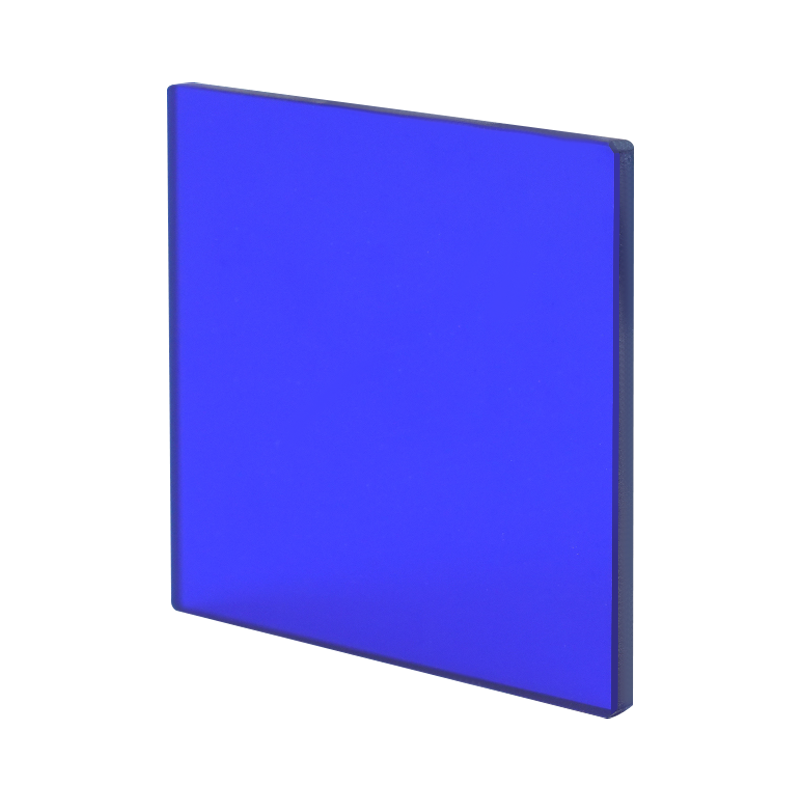
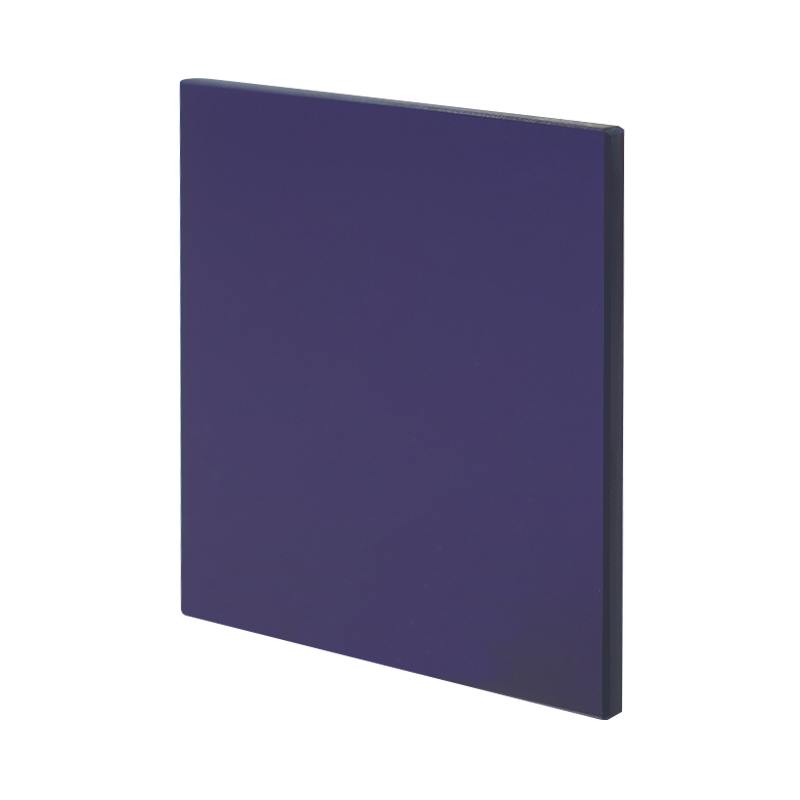
Manganese, titanium, cobalt and neodymium combinations produce purple toned glass that absorbs strongly in the mid spectrum green and yellow region while letting violet, blue and part of the red band pass through.
Specialized formulations built as a UV absorbing glass optical filter cut off shorter wavelengths near 365 nanometers and below while passing the visible band with a flat, even response.
Beyond visible light work, an infrared transmitting glass filter manufacturer can dope the same base glass system to pass near infrared energy while blocking visible light, which is useful in sensor windows that need to reject ambient light interference.
What An Optical Coating Filter Is And How Its Principle Differs
An optical coating filter starts as a clear substrate, often plain glass or fused silica, onto which many extremely thin layers are deposited one at a time inside vacuum deposition equipment. Each layer carries a different refractive index, and the stack is engineered so light reflecting between layers interferes constructively at wavelengths meant to be blocked and destructively at wavelengths meant to pass. This is fundamentally an interference effect rather than an absorption effect, which is the core distinction separating it from a selective absorption glass filter.
Common Coating Families In Everyday Use
Dichroic stacks that reflect one color band while transmitting another.
Narrow bandpass coatings built for a single tight wavelength window.
Notch coatings designed to reject one narrow band while passing everything around it.
Because the filtering behavior depends on the exact path length light travels through each layer, the transmission curve of a coating filter shifts toward shorter wavelengths as the angle of incoming light increases. A coating rated for a precise cutoff at normal incidence can drift several nanometers off target once light arrives at even a moderate angle, which matters in compact optical systems where rays rarely travel in a single straight line.
Core Differences Between The Two Filter Technologies
The table below lines up both technologies across the physical properties that most often decide which one fits a given design.
Table 1. Physical and performance comparison between selective absorption glass filters and optical coating filters.
Parameter
Selective Absorption Glass Filter
Optical Coating Filter
Working Principle
Bulk absorption through doped glass
Thin film interference on a substrate
Angle Sensitivity
Very low
Noticeable at wide angles
Cutoff Edge Sharpness
Gradual, natural slope
Can be engineered very steep
Thermal Sensitivity
Low across normal ranges
Moderate, layer dependent
Delamination Or Wear Risk
None, the property sits in the bulk material
Possible under humidity or abrasion
Customization Method
Adjust glass composition and doping level
Adjust layer count and thickness
Performance Comparison Across Five Key Optical Parameters
The horizontal chart below scores both filter families on a relative zero to one hundred scale across five parameters that optical engineers check most often during component selection. These scores reflect typical behavior observed across common production samples rather than any single test report.
Angle independence and long term color consistency show the widest gap, which is why selective absorption glass filters remain a common choice for viewfinders, wide aperture lenses and any housing where light rarely hits the filter straight on.
Spectral Transmission Behavior Of A Typical Green Selective Absorption Glass Filter
The chart below traces a representative transmission curve for a green toned selective absorption glass filter doped with chromium and copper ions. Transmission rises quickly once wavelength approaches 480 nanometers, reaches a broad peak between 500 and 560 nanometers, then falls away smoothly on the long wavelength side. This gentle rise and fall is characteristic of bulk absorption glass and is one reason these filters produce a natural, even color rendering rather than the harder edged output typical of a narrow coating stack.
Because the curve slopes gradually rather than dropping in a near vertical line, small manufacturing variations in glass thickness or doping concentration shift the peak only slightly, keeping batch to batch color consistency well within tolerance for most instrument and lighting applications.
Where Selective Absorption Glass Filters Are Used Across Industries
Demand for a glass filter for wavelength selection spans several industries, and the relative share below reflects the typical order of magnitude seen across current production orders.
Representative Application Notes
Optical instruments including fluorescence microscopes, DNA sequencers and spectrometers rely on an optical absorption glass filter for sensors to strip stray light before it reaches the detector.
Industrial processes such as semiconductor lithography and UV curing use absorption glass as a stable window material that limits heat build up on sensitive substrates.
Stage and photographic lighting use colored absorption glass to shape visible color while blocking infrared heat radiation from reaching the illuminated subject.
Architectural glazing and automotive glass use tinted absorption layers to reduce solar heat gain while keeping a comfortable interior light level.
Medical and biochemical instruments depend on consistent spectral response for accurate readings across repeated testing cycles.
Multi Dimensional Comparison Radar Chart
Six dimensions matter most when weighing a selective absorption glass filter against a coating filter for a new design. The radar chart below plots both technologies on the same scale so the trade offs are visible at a glance.
Coating filters extend further on spectral selectivity and manufacturing flexibility, since a deposition process can target an unusual wavelength combination that no single glass formula reaches on its own. Absorption glass extends further on angle independence, thermal stability and long term consistency, which explains why it remains common in fixed optical paths that stay in service for many years.
Environmental Stability And Long Term Durability In Real Conditions
Selective absorption glass filters carry their optical property inside the material itself, so light scratching of the surface or exposure to humidity does not change the wavelength band it absorbs, only its physical clarity if damage becomes severe. Coating filters carry their optical property in a stack of layers only a few microns thick, which means humidity ingress, repeated cleaning, thermal cycling or long term UV exposure can gradually loosen or oxidize individual layers. Once a layer shifts even slightly, the whole interference pattern shifts with it, changing the effective cutoff wavelength over time.
Where This Difference Shows Up Most
Outdoor architectural glazing, automotive glass exposed to direct sun, and industrial equipment operating near heat sources are the settings where the gap between the two technologies becomes most visible over a multi year service period. Cleanroom and laboratory instruments kept in a controlled environment see a smaller practical difference, though angle sensitivity still favors absorption glass whenever the optical path is not perfectly collimated.
Typical Stress Points Checked During Evaluation
Buyers commonly run their own thermal cycling checks, humidity soak checks and repeated wipe cleaning checks on sample pieces before committing to a production order, since these three stress points reveal most of the practical difference between bulk glass and a deposited coating stack.
Customization Options For Selective Absorption Glass Filters
Buyers sourcing a custom selective absorption glass filter typically start from a target transmission curve rather than a fixed catalog part. A colored optical glass absorption filter supplier can adjust several variables to reach that curve.
Doping type and concentration to move the absorption band toward a specific target wavelength.
Glass thickness, since absorption depth follows the optical path length through the material.
Surface finish and edge treatment for mounting inside a specific housing or sensor module.
Combined constructions that pair an absorption glass core with a thin anti reflection layer, useful when a project wants the stability of absorption glass with slightly higher overall transmission.
Requests routed to a custom wavelength optical filter glass line, an infrared transmitting glass filter manufacturer relationship, or an absorptive optical filter glass supplier that can hold tight batch to batch tolerance usually move faster when the buyer shares a target transmission curve, the operating temperature range, and the physical mounting dimensions up front.
Nantong Xiangyang Optical Element Co., Ltd has produced colored and colorless optical glass since 1996 from a ten thousand square meter facility in Jiangsu Province. The optical components division focuses on colored optical glass filters covering the ultraviolet, visible, near infrared and infrared regions, running well over one hundred glass types through processing lines equipped with dedicated optical grinding, polishing and spectral testing equipment. Output from this division reaches optical instruments, medical and biochemical instruments, analytical equipment, electronics, aviation and a number of research institutes and universities.
A separate flat glass division handles glass silk screen printing and tempering for control panels, appliance housings and switch components, which keeps the company familiar with both precision optical glass and mass production glass processing under one roof. For a project team comparing a selective absorption glass filter manufacturer against an optical filter glass manufacturer China wide, this combination of dedicated optical testing equipment and a long running production history is one of the practical signals worth checking during supplier evaluation.
How To Choose Between Selective Absorption And Coating Filters For A Project
A short checklist helps narrow the decision before requesting samples.
Map the required wavelength band and check whether a standard colored glass type already covers it closely.
Confirm the range of incidence angles the filter will see in the actual optical path, not just at the design center.
Note the operating environment, including humidity, temperature swings and exposure to outdoor UV.
Decide how steep the cutoff edge needs to be, since a very narrow passband may still call for a coating solution.
Plan for the expected service life and how difficult recalibration or replacement would be once the unit is deployed in the field.
Projects that check most of the boxes above in favor of stability and simplicity typically settle on a selective absorption glass filter, while projects that need an unusually narrow or steep spectral edge often end up specifying a coating filter or a combination of both technologies within the same optical path.
Frequently Asked Questions About Selective Absorption Glass Filters
Q1: What is a selective absorption glass filter
It is an optical glass formulated with metal ions or colloidal particles so that it absorbs a chosen wavelength band while transmitting the surrounding light with little loss.
Q2: How does an absorption glass filter block specific wavelengths
Doped ions inside the glass absorb photons whose energy matches an internal electron transition, removing that wavelength band while leaving other wavelengths largely unaffected.
Q3: What is the difference between absorption filters and interference filters
Absorption filters remove light through the bulk glass material, while interference filters use thin deposited layers that reflect and cancel unwanted wavelengths through optical interference.
Q4: Why use colored glass filters instead of coated filters
Colored glass holds its spectral response steady across wide viewing angles and resists the gradual layer degradation that can affect a coated surface over years of use.
Q5: What are selective absorption filters used for
Common uses include optical sensors, machine vision systems, spectroscopy equipment and medical instruments that need a stable, repeatable spectral response.
Q6: Which optical filter is suitable for UV protection
A UV absorbing glass optical filter formulated to cut off shorter wavelengths is generally the simpler and more stable option for continuous UV protection duty.
Q7: Can absorption glass filters be customized
Yes, doping type, concentration, thickness and surface finish can all be adjusted to reach a target transmission curve for a specific project.




 English
 Español