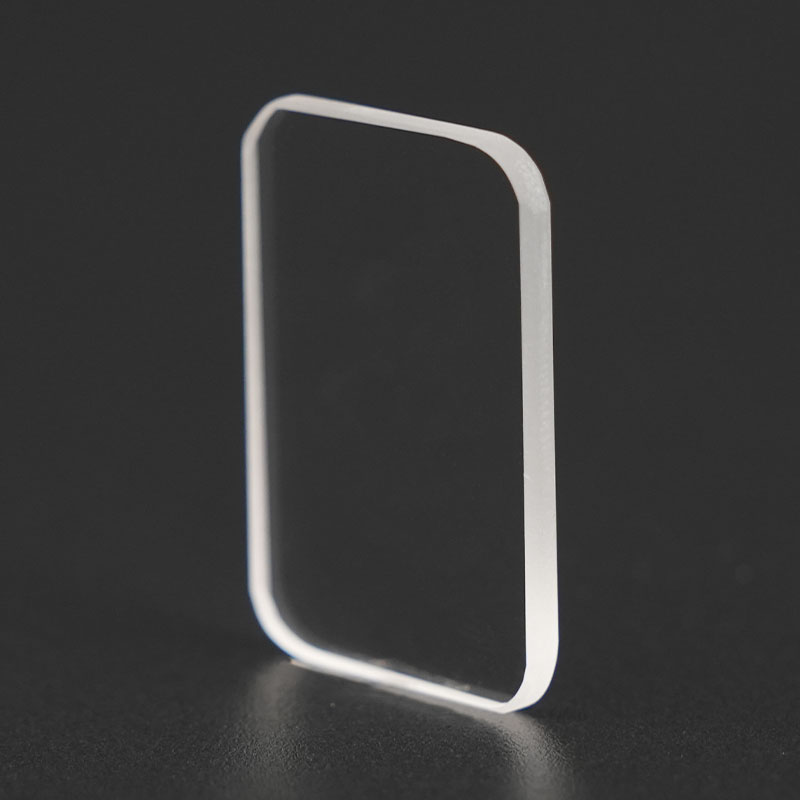
A pump laser window in a photonics assembly has just failed after 200,000 thermal cycles. The failure report points to sodium migration and devitrification in the borosilicate window. This is a recurring problem when ordinary glass is used in deep-UV or high-temperature optical systems. Fused quartz glass does not fail that way. It is essentially pure silica (SiO2) in amorphous form, and its continuous silica network gives it a thermal expansion coefficient roughly six times lower than borosilicate glass. It transmits light from the deep ultraviolet through the mid-infrared, and it resists chemical attack that degrades standard glass. That is why semiconductor processing, photolithography, spectroscopy, and high-temperature observation systems specify fused quartz glass as the standard solution. This guide explains what fused quartz glass is, how it compares with other glass families, and what you should check before specifying it for your system.
Fused quartz glass is a non-crystalline glass made of almost pure silicon dioxide. In a standard float glass, network modifiers such as sodium, potassium, and calcium break up the silica network and create weaker bonding structures. In fused quartz glass, the network stays a continuous SiO2 framework. That framework is the physical reason behind the material's high softening point, low thermal expansion, deep-UV transmission, and chemical resistance.
The production route also affects final properties. Fused quartz normally starts from natural quartz crystal, which is crushed and melted at around 2000 °C. Fused silica starts from a synthetic precursor such as silicon tetrachloride, which is hydrolyzed in a flame or plasma. Both products are amorphous SiO2, but synthetic fused silica has higher purity and more controlled hydroxyl content. For many optical window, substrate, and filter applications, fused quartz glass from an experienced processor delivers the needed transmission and thermal stability at a lower cost than synthetic fused silica.
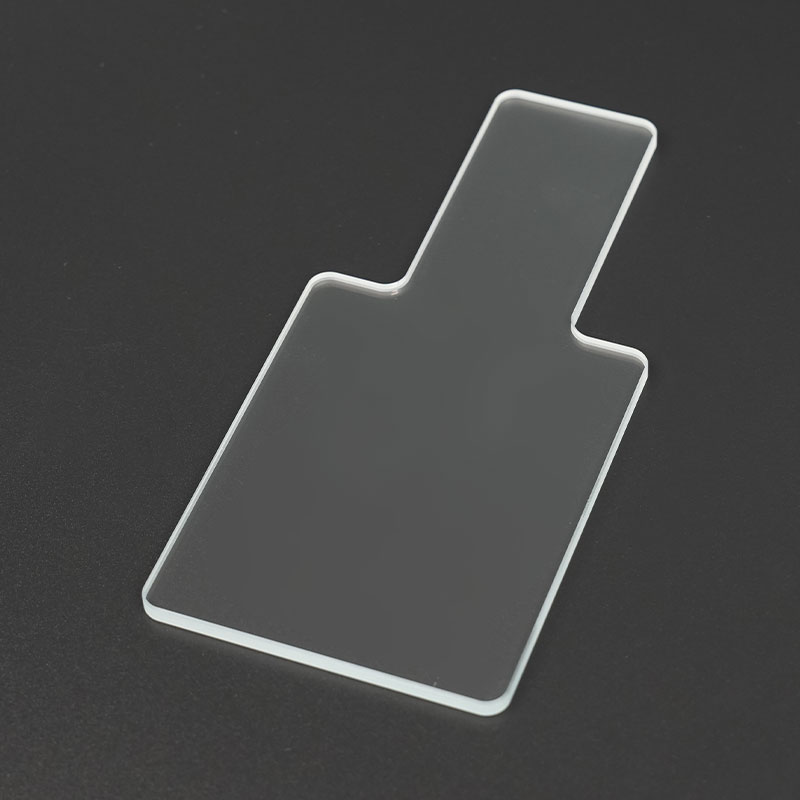
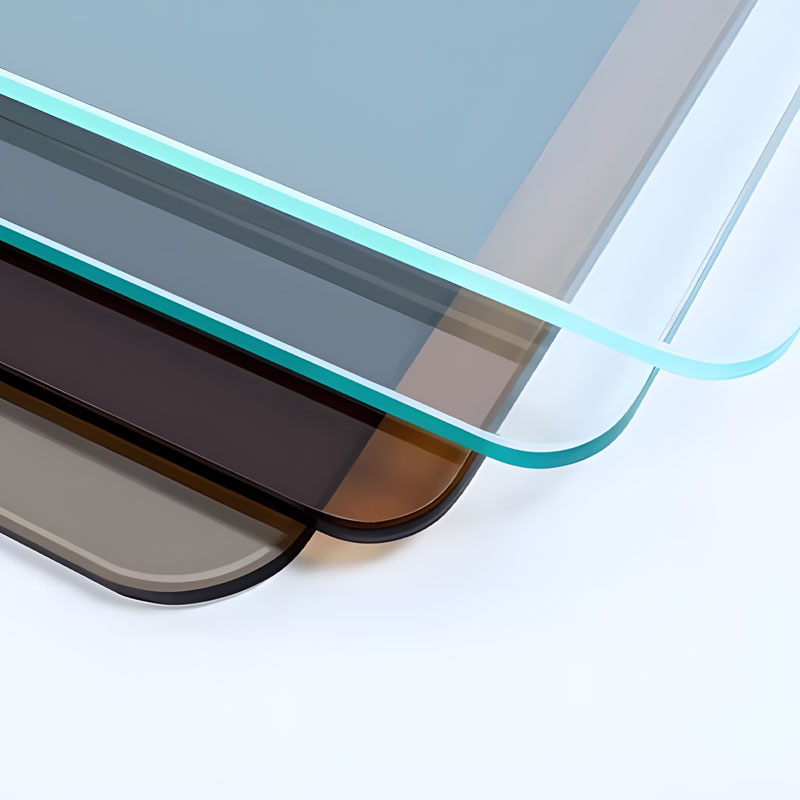
At Nantong Xiangyang Optical Element Co., Ltd., colorless quartz optical glass is one of the colorless optical glass products we process and supply. It is available in sheet, plate, and shaped formats for optical filters, windows, prisms, and substrates.
A comparison table is the fastest way to position fused quartz glass in the right category. The key variables are purity, UV transmission, thermal stability, chemical durability, and relative cost.
Comparison of fused quartz, fused silica, borosilicate, and soda-lime glasses
Material
SiO2 Purity
UV Cutoff
CTE (×10-6/K)
Continuous Service Temp
Relative Cost
Fused Quartz Glass
≥ 99.9%
~185 nm
0.55
1100 °C
Moderate
Fused Silica
≥ 99.99%
~170 nm
0.50
1200 °C
High
Borosilicate
~80%
~300 nm
3.30
450 °C
Low
Soda-Lime Glass
~70%
~350 nm
9.00
250 °C
Very Low
The practical takeaway is that borosilicate glass remains useful for laboratory glassware and general windows, and soda-lime glass is fine for everyday glazing. But if your system needs working transmission down to 185 nm or continuous operation above 450 °C, neither material is adequate. Fused quartz glass bridges that gap with acceptable cost and proven optical performance.
Key Properties of Fused Quartz Glass
Optical engineers check two properties first: thermal expansion and spectral transmission. The bar chart below shows how the coefficient of thermal expansion (CTE) of fused quartz glass compares with common alternatives.
Fused quartz glass has a CTE of roughly 0.55 × 10⁻⁶/K. That is about six times lower than borosilicate glass and sixteen times lower than soda-lime glass. In practical terms, a 100 mm fused quartz window changes dimension by about 0.005 mm when heated 100 K, while a soda-lime window grows by nearly 0.09 mm. When components must hold alignment under continuous heating, that difference decides whether the system stays in tolerance.
The next performance factor is spectral transmission. The chart below compares transmission curves of fused quartz, borosilicate, and soda-lime glass across the 200–2000 nm range.
The same material also provides continuous transmission from 185 nm into the mid-infrared, with negligible absorption in the 200–2000 nm range. Because of this broadband transparency, spectroscopy, laser systems, and photolithography use fused quartz as a window, prism, and substrate material. In an oxidizing environment, it can run continuously at 1100 °C, and short excursions to 1300 °C are possible with proper support.
How Is Fused Quartz Glass Manufactured?
The production route splits into natural-quartz melting and synthetic deposition. For fused quartz, the process starts with cleaned natural quartz crystal, crushed to controlled size, then melted in a continuous furnace at around 2000 °C. The melt flows from a platinum or ceramic nozzle and is cooled slowly to prevent devitrification. The isometric structure below illustrates the plate form that most optical components use.
After melting and slow cooling, the glass goes through cutting, rough grinding, and fine polishing. For optical components, final surface quality usually reaches 40/20 scratch-dig or better, with flatness controlled to a fraction of a wavelength. Inspection covers birefringence, bubble content, and transmission at the wavelengths where the customer will run the component.
In the synthetic route, silicon tetrachloride is hydrolyzed in a high-temperature flame or plasma to deposit SiO2 directly. The resulting fused silica has lower metallic impurity and can be engineered for specific OH content, which matters when the application needs high transmission near 2.7 µm. However, processing cost is significantly higher than for fused quartz, so the choice depends on the required spectral band and budget.
Where Is Fused Quartz Glass Used?
Fused quartz glass moves from raw material into high-value end products in several technology sectors.
Semiconductor processing: quartz windows, viewports, and furnace components handle repeated thermal cycling and corrosive gases.
UV photolithography: mask substrates and lens windows require deep-UV transmission with minimal absorption.
Spectroscopy: cuvettes and sample cells need broad spectral transparency for precise analytical results.
Laser systems: beamsplitters and protective windows use the material as a reliable optical medium.
High-temperature sight glasses: furnace observation ports need resistance to thermal shock and oxidative attack.
Precision optics: prisms, mirrors, and filter substrates benefit from low thermal distortion and uniform refractive index.
For companies that need fused quartz glass for these applications, selecting a processor with real optical experience matters more than comparing basic prices. Our production facility at Nantong Xiangyang processes colorless quartz optical glass and other colorless optical glass types to customer drawings for both domestic and export clients.
How to Choose Quality Fused Quartz Glass
A short purchasing checklist is more useful in practice than a long specification sheet. The following five points cover the decisions that affect actual system performance.
Match the transmission requirement to OH content. For UV applications, low-OH fused quartz gives better deep-UV transmission. For mid-IR use, high-OH content can reduce absorption near 2.7 µm.
Confirm the thermal specification. Check the continuous service temperature and short-term peak with the supplier, because softening temperature depends on purity and forming method.
Check surface quality and flatness. For optical windows, 40/20 scratch-dig is a common starting point. If the component goes into a laser cavity, request tighter flatness and lower wavefront error.
Verify purity and bubble tolerance. The presence of bubbles and metallic impurities directly affects scattering and absorption in demanding systems.
Ask about customization. Non-standard sizes, shaped prisms, holes, and mounting slots are all practical when the supplier can process glass in-house.
For a typical UV window, the supplier should provide documented transmission data. Asking for a transmission curve from 185 nm to 2500 nm gives a direct comparison against your system requirement, separating a properly processed glass from a generic material grade. For a broader look at how colorless optical glass is used across industries, refer to this guide on colorless optical glass applications.
When the application calls for the lowest possible absorption across the visible band, ultrawhite colorless optical glass is a suitable option. It retains a polished surface and low bubble content for precision imaging and illumination systems.
Frequently Asked Questions
Q1: What is fused quartz glass?
A1: Fused quartz glass is an amorphous solid made of almost pure silicon dioxide (SiO2). Its continuous silica network gives it low thermal expansion, deep-UV transmission, and high chemical resistance.
Q2: Fused quartz vs fused silica: What is the difference?
A2: Fused quartz starts from natural quartz crystal, while fused silica starts from a synthetic silicon precursor. Fused silica has higher purity and more controlled OH content, but fused quartz offers a more cost-effective solution for many applications.
Q3: What temperature can fused quartz glass withstand?
A3: Fused quartz can operate continuously at 1100 °C, and short excursions to 1300 °C are possible. This thermal stability is far above borosilicate and soda-lime glass.
Q4: Does fused quartz glass transmit UV light?
A4: Yes. Good-quality fused quartz transmits ultraviolet light starting around 185 nm, making it the standard material for UV photolithography and spectroscopy.
Q5: What is fused quartz glass used for?
A5: Common uses include semiconductor windows, UV optics, spectroscopy cuvettes, laser protective windows, and high-temperature sight glasses.
Q6: How much does fused quartz glass cost?
A6: Fused quartz costs more than borosilicate or soda-lime glass due to high-temperature melting and purity requirements, but it is generally more affordable than synthetic fused silica. Price depends on size, thickness, surface quality, and quantity.




 English
 Español