Home · News · Industry News · Selective Absorption Glass: Applications, Selection Criteria, and Practical Guidance
Selective Absorption Glass: Applications, Selection Criteria, and Practical Guidance
Author: AdminDate: Oct 19,2026
An optical engineer has a transmission curve that looks perfect at normal incidence. Then the filter is tilted 15 degrees, the light source heats the glass, or the next production lot arrives with a slightly different tint. The image shifts. That is the moment when the difference between a bulk-doped absorption glass and a thin-film coating becomes a purchasing issue, not a textbook one.
Short answer: selective absorption glass is usually the better fit when you need broad wavelength rejection, tolerance to angle changes, and a robust part. It is a poor fit when you need an extremely sharp spectral edge with almost no heat deposited in the glass.
Here is what to check before you approve a drawing or a purchase order.
What Selective Absorption Glass Does in an Optical Path
Selective absorption glass is optical glass with absorbing centers built into the bulk. Instead of relying on a surface coating to reflect a band of light, the glass itself contains dopants that absorb selected wavelengths and turn that energy into heat. Common dopant families include copper, iron, cobalt, nickel and rare-earth ions. The exact mix determines where the glass transmits, where it absorbs and how sharp the transition can be.
That bulk behavior has two practical consequences. First, the filter is less sensitive to tilt than an interference coating, because the absorption centers are distributed through the material rather than stacked in thin layers. Second, transmission depends on thickness. A glass that reaches the required blocking density at 2 mm may be too pale at 1 mm or too dark at 4 mm. For high-absorption glasses, a thickness change of a few tenths of a millimetre can move density noticeably.
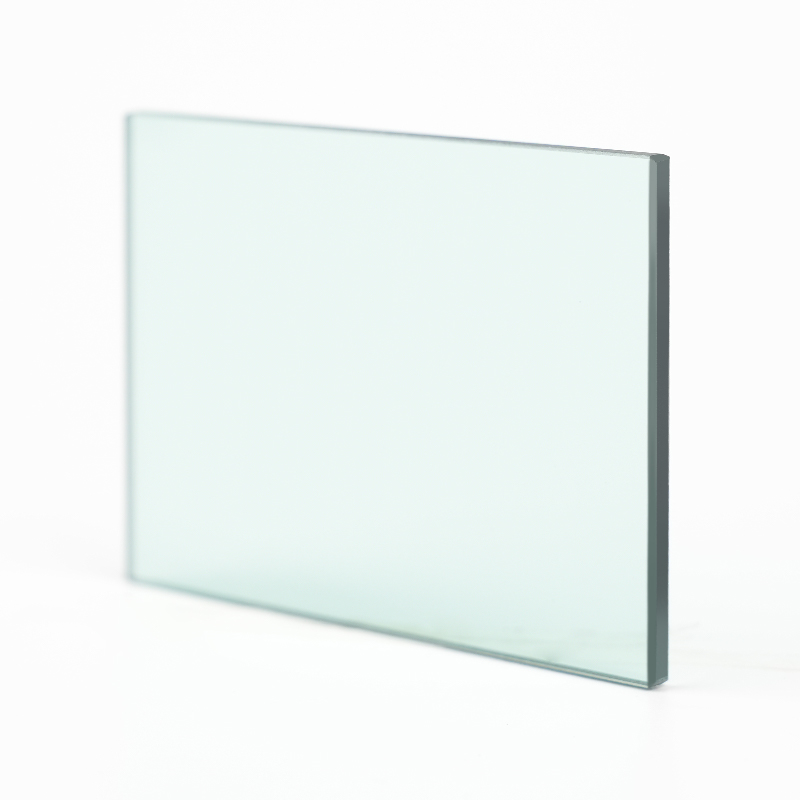
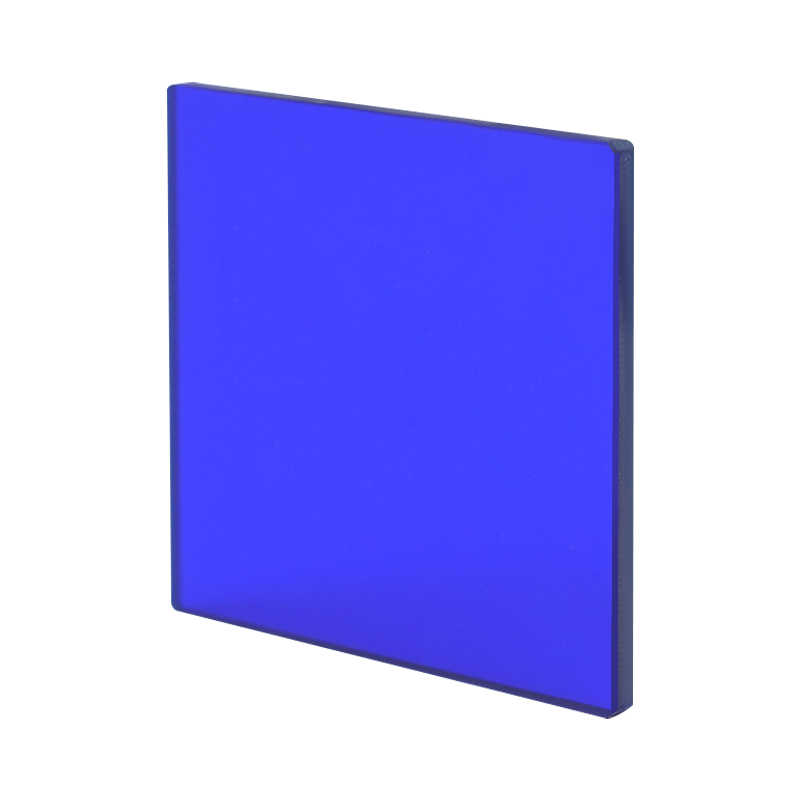
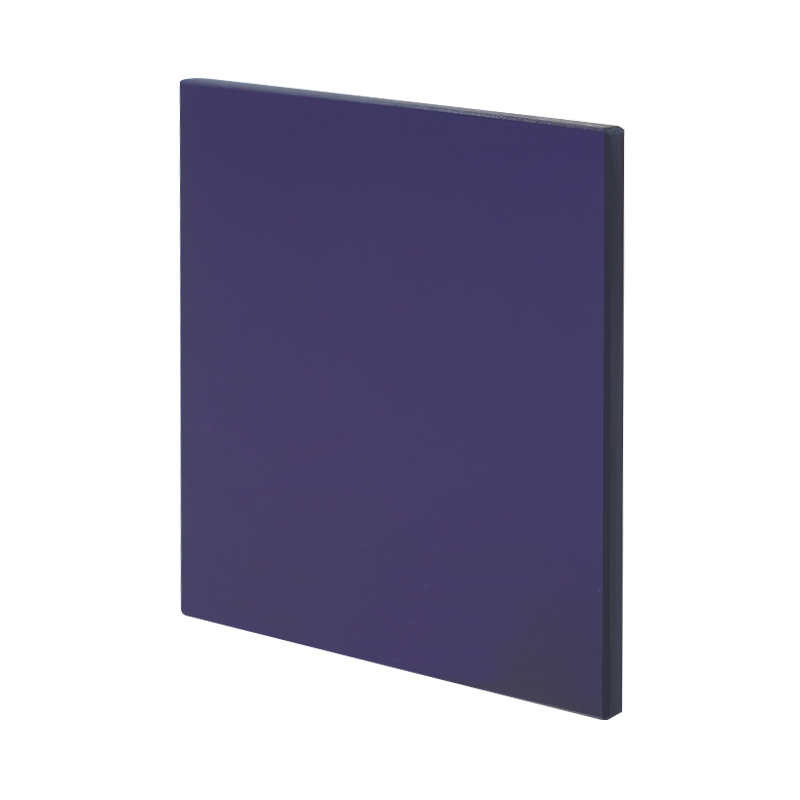
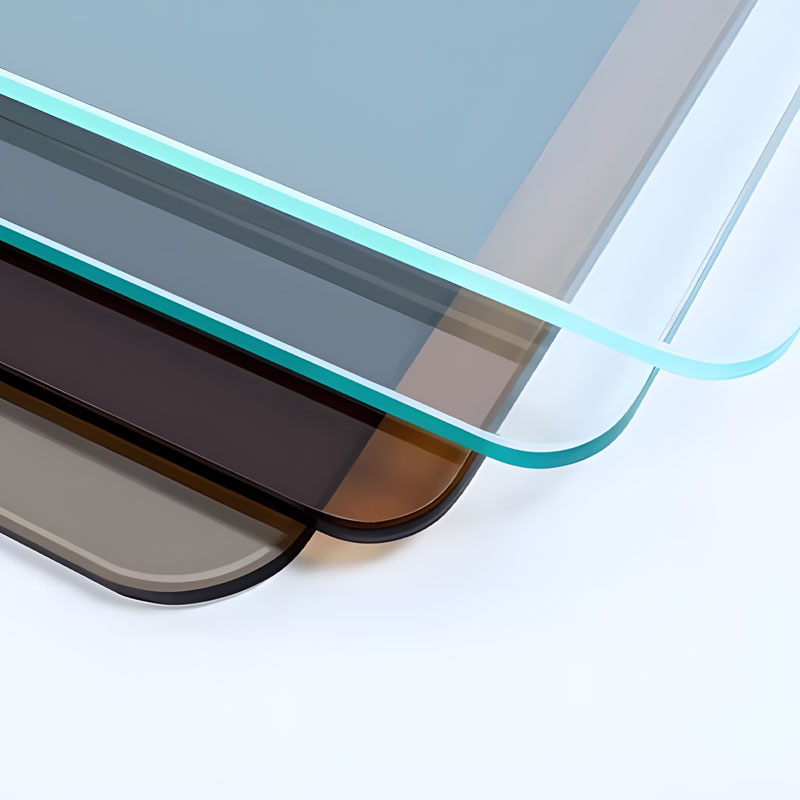
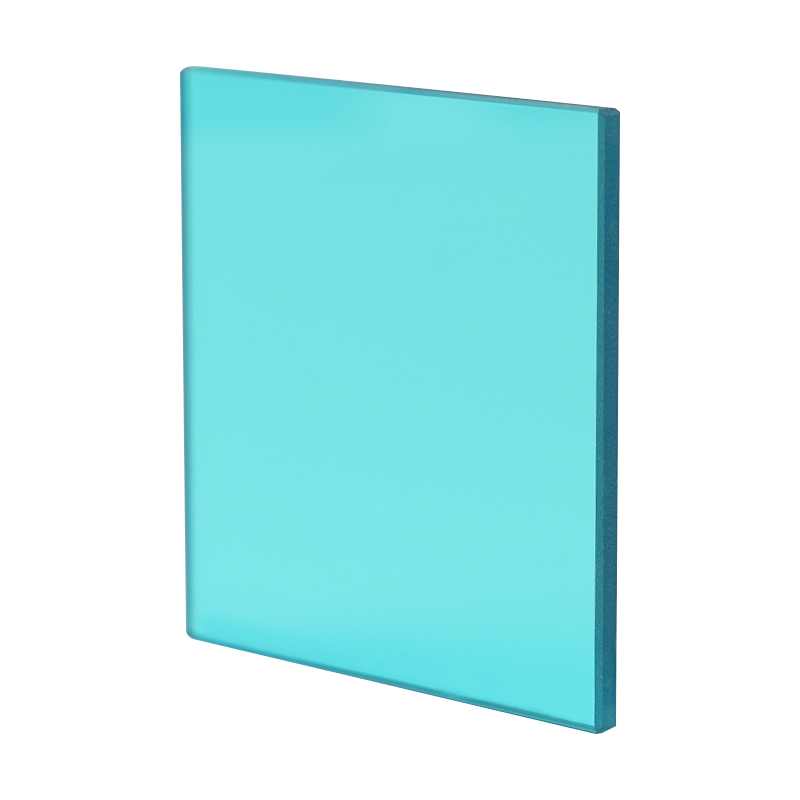
Typical commercial grades include UV cut-off glass, cyan-blue infrared absorbing glass, green optical filter glass, heat-absorbing glass, UV-visible absorption glass and wavelength calibration glass. They are often chosen by function rather than by color name: “block the near-infrared while passing visible,” “suppress UV below the visible band,” or “hold a calibration edge stable over time.”
Start with the curve, not the color name. Two glasses can look similar in ambient light and behave very differently at 850 nm or 365 nm. Ask for absolute transmission at the wavelengths that matter, plus blocking density in the stopband. A curve measured on a 1 mm witness piece is not enough for a 3 mm production part.
Table 1. Specification questions that separate a workable filter from a costly rework.
Parameter
Why it matters
What to request
Common failure
Wavelength band and blocking level
Defines what must pass and what must be suppressed.
Absolute transmission at 5–6 key wavelengths and optical density in the stopband.
Accepting an average transmission value with no stopband data.
Cut-on or cut-off slope
Controls color, contrast and sensor response.
Wavelength at 10%, 50% and 80% transmission.
Quoting only the 50% point while the edge is too soft for the detector.
Thickness and tolerance
Absorption is a bulk effect, so thickness changes density.
Curve at final thickness, plus dimensional tolerance and parallelism.
Approving a sample at one thickness and ordering production at another.
Homogeneity and striae
Index variation and internal streaks can spoil imaging or calibration.
Optical grade, striae class and inspection method.
Using a color-grade glass where wavefront quality is required.
Thermal load
Absorbed light becomes heat inside the glass.
Use conditions, absorption estimate, thermal expansion and thermal-shock data.
Ignoring heat until the filter shifts or fractures in the fixture.
For imaging systems, also ask about surface quality, flatness, edge chips and whether an anti-reflective coating is needed. The absorption glass may control the spectrum, but the surface still controls stray light and image contrast.
Selective Absorption vs Coating Filters: Where Each Wins
Absorption glass and dielectric coating filters solve different problems. An absorption filter is usually more stable when the beam angle changes, because the light path through the bulk changes only modestly at moderate tilt. A coating filter relies on interference, so its spectral position can move as incidence angle increases. That is why a coated short-pass filter may look perfect on axis and leak at the edge of a wide-angle system.
The trade-off is heat. Absorption glass converts rejected light into thermal energy inside the substrate. A coating filter reflects the rejected band, so the heat may land elsewhere in the assembly. Neither approach is automatically better; the decision depends on where heat can go, how sharp the edge must be, and how much angle variation the system will see.
Qualitative industry-practice scorecard, 1–5. Actual filters vary by design, coating stack and glass grade.
Reading a Transmission Curve Before You Buy
A useful datasheet shows the curve at the thickness you will install, states the measurement angle and identifies the blocking band. Check optical density rather than a rounded “0% transmission” claim. In many systems, OD 3, OD 4 and OD 5 are not interchangeable, especially when a sensitive camera or photodetector is involved.
It also helps to separate absorption from reflection. A polished glass surface reflects roughly 4% per surface in the visible region unless it is coated, so a transmission curve near 92% may already be close to the practical limit for an uncoated part. If the system needs higher throughput, ask for an anti-reflective coating and evaluate it on the final glass, not on a bare witness.
Illustrative spectral behavior
Illustrative curve shapes only; they are not a specification for any product.
Applications and Field Checks
Selective absorption glass appears wherever a system needs a stable spectral boundary without relying only on thin-film interference. Machine-vision cameras use it for color separation and IR suppression. UV systems use it to protect sensors and materials while passing visible light. Photography filters use it for color correction and IR cut-off. Industrial heat-rejection assemblies use it to absorb near-infrared energy before it reaches a detector. Metrology and calibration fixtures use selected grades to hold a known edge.
The same principle appears at architectural scale. Lawrence Berkeley National Laboratory describes spectrally selective glazing as window glass that permits some portions of the solar spectrum to enter a building while blocking others. Optical filters apply that idea with far tighter tolerances, but the design question is similar: decide which wavelengths do useful work and which ones create heat, glare or noise.
Isometric view: absorption happens through the glass volume, not at a single surface.
For a deeper comparison of material behavior, coating alternatives and application notes, see our guide to selective absorption glass filters.
A Practical Sourcing Checklist
Define the passband, stopband and required optical density at the actual use angle.
Fix the final thickness and tolerance before approving the curve.
Estimate absorbed power and check thermal expansion, thermal shock and mounting stress.
Specify optical homogeneity, striae class and surface quality for imaging or calibration use.
Confirm edge finish, chamfer, coating option and cleaning compatibility.
Ask for lot-level transmission data and a sample that can be measured on your own spectrophotometer.
If the application is sensitive to lot-to-lot color shift, request a revalidation plan rather than a one-time certificate. Absorption glass is a material system, not a printed label; small changes in melt chemistry can matter in tight spectral systems.
Send your target curve, thickness, quantity and use environment to our team through the contact page to confirm a suitable grade or custom option.
Frequently Asked Questions About Selective Absorption Glass
Q1. What is selective absorption glass used for?
It is used to remove or reduce specific wavelength bands in machine vision, UV protection, photography, heat rejection, calibration and other optical systems that need stable spectral control.
Q2. How is it different from a coated optical filter?
Absorption glass works through dopants in the bulk, while a coating filter uses thin-film interference. Absorption is usually less angle-sensitive; coatings usually offer sharper edges.
Q3. Can selective absorption glass block UV and IR?
Some grades suppress UV, some absorb near-infrared, and some combine both functions. The exact blocking range and optical density depend on the glass composition and thickness.
Q4. Does thickness change the transmission curve?
Yes. Because absorption occurs throughout the volume, thicker glass normally produces stronger blocking and lower transmission near the absorption band.
Q5. How do I request a custom selective absorption glass filter?
Provide the target transmission curve, blocking level, thickness, dimensions, surface requirements and operating conditions. A supplier can then recommend a grade or a custom melt and finishing route.
Q6. How should selective absorption glass be cleaned?
Use a soft lens tissue or lint-free cloth with a mild optical cleaner. Avoid abrasive pads and aggressive solvents that could attack edge coatings, printed marks or mounting adhesives.




 English
 Español