Home · News · Industry News · Absorption Glass Filter Guide: How It Works, Key Specs, and Sourcing Tips
Absorption Glass Filter Guide: How It Works, Key Specs, and Sourcing Tips
Author: AdminDate: Oct 21,2026
Picture a small OEM building a handheld colorimeter. A coated bandpass filter would separate the channels cleanly, but at a few hundred units a year the coating price and the angle shift at f/1.8 make the design awkward. A 3 mm disc of cyan-blue glass absorbs most of the red leak instead, costs far less, and does not care that the beam arrives at 25 degrees.
That is the fair case for an absorption glass filter: broadband blocking, gentle edges, moderate cost and very little sensitivity to beam angle. The case against it is just as simple. If the drawing says 10 nm full width at half maximum, or OD6 of blocking between passband and detector, bulk-colored glass will not deliver it, and polishing harder will not change that.
What follows is how the material actually attenuates light, how to read a curve at the thickness you are buying, which glass families cover the common jobs, and the tolerances that cause most purchase-order disputes.
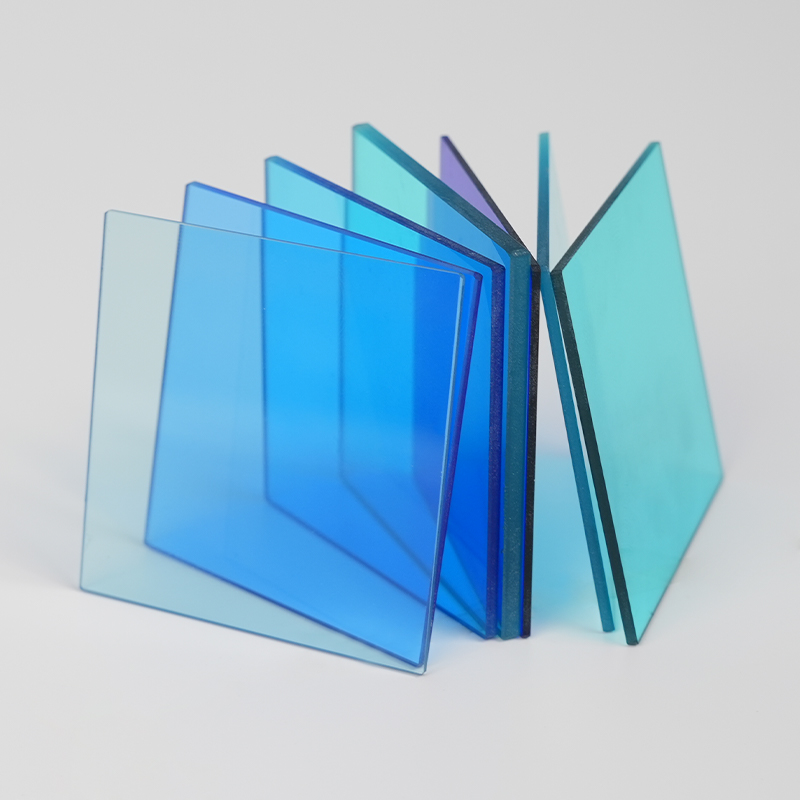
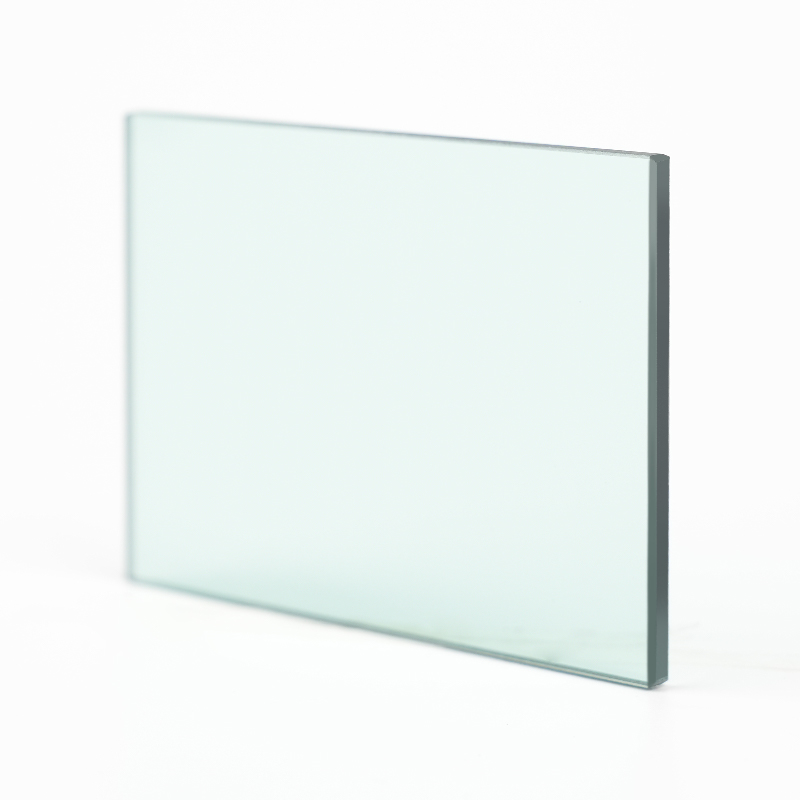
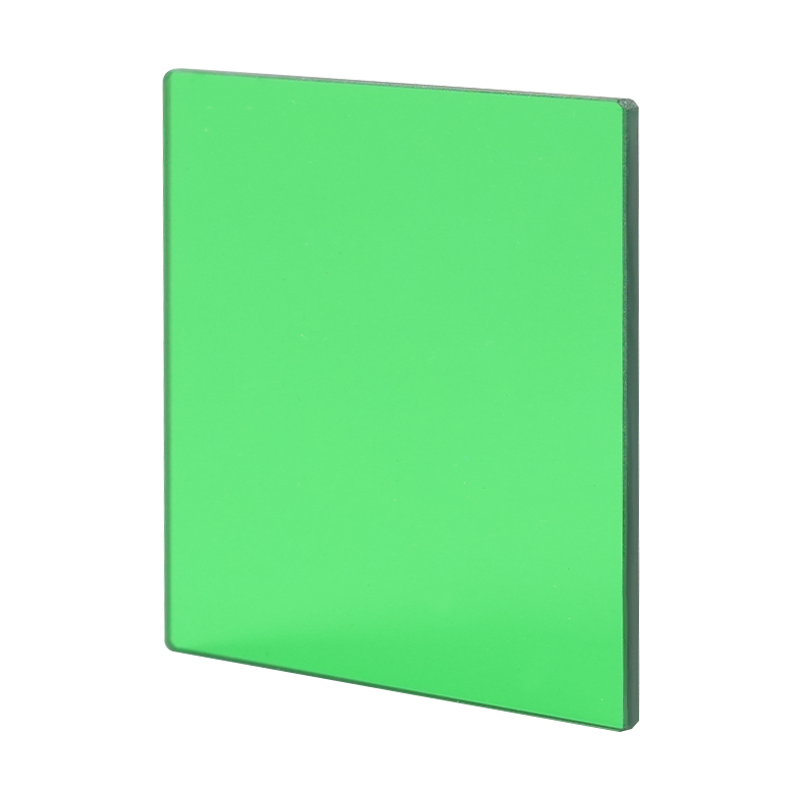
An absorption glass filter is made from optical glass colored in the melt. Metal ions or other colorants are dispersed through the material, so attenuation happens through the full volume rather than at a surface. There is no dielectric stack, no coating interface and nothing to delaminate in humidity.
Two consequences follow. First, the spectral curve is a property of the glass composition and the optical path length together. Internal transmittance follows the Beer-Lambert relationship, roughly exp(−αd), where α is the absorption coefficient at that wavelength and d is the thickness. Doubling the thickness does not halve transmission, it squares it: a glass that transmits 80 percent internally at 2 mm transmits about 64 percent at 4 mm.
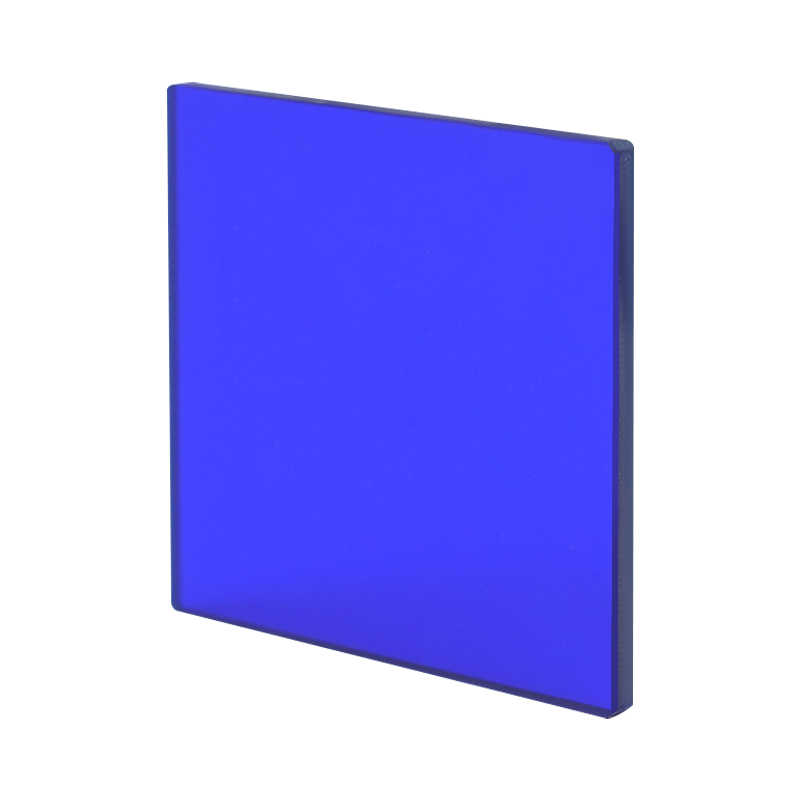
Second, the filter shows one color in transmission and the complementary color in reflection. A cyan-blue glass that passes blue-green light looks orange-red on its surface. That is a quick way to sanity-check a shipment before it reaches the bench.
Because absorption turns photons into heat, high-power sources deserve attention. A filter in front of a 100 W lamp absorbs the blocked band as thermal energy, and colored glass is more sensitive to thermal shock than fused silica. Mount it with clearance, avoid clamping the rim hard, and keep the absorbed load inside the glass maker's guidance.
Schematic: attenuation happens throughout the volume, so the optical path length and the glass composition set the curve together.
Absorption Glass vs. Coated Interference Filters
Both parts will be called "the filter" on the drawing, and both can sit in the same optical path. Their behaviour differs enough that the choice should come from the specification, not from a catalogue photo.
Table 1: Practical differences that decide most filter specifications.
Parameter
Absorption glass filter
Coated interference filter
Bandwidth
Broad, typically tens to hundreds of nanometres
Narrow, commonly 1 to 50 nm
Peak transmission
Usually 70 to 90 percent in the passband
Often 90 to 98 percent at the centre wavelength
Blocking outside the band
Limited to a few OD and strongly wavelength dependent
Deep, can reach OD6 and beyond with multi-cavity designs
Angle of incidence
Small shift; usable over a wide cone
Blue-shifts markedly as the angle increases
Effect of thickness
Curve changes with thickness, per Beer-Lambert
Fixed by the coating design
Thermal behaviour
No coating to degrade, but absorbs light and warms up
Coating can shift with temperature; hard coatings are durable
Relative cost at low volume
Lower
Higher, especially for custom bands
Typical fit
Broadband trimming, UV or IR blocking, heat control, cost-sensitive OEM work
Reading a Transmission Curve at the Right Thickness
Catalogue curves are usually plotted at one reference thickness, most often 2 mm or 3 mm. Before comparing two suppliers, confirm the thickness behind the numbers: a 74 percent figure at 3 mm and an 82 percent figure at 1 mm may describe exactly the same glass.
Check how the cut-on wavelength is defined. It is often the 50 percent point of internal transmittance, not of measured transmission.
Check whether the curve is internal transmittance or includes Fresnel reflection, which costs roughly 4 percent per uncoated surface at a refractive index near 1.5.
Check the residual leak beyond the blocking band. Even a visually black region usually passes a fraction of a percent, which matters for silicon detectors that respond to 1100 nm.
Check the stated tolerance on the cut-on wavelength. Colored glass melts are commonly quoted around plus or minus 10 nm, with tighter screening available against measured data.
Check thickness and parallelism, because a wedge shifts the effective cut-on across the aperture.
Illustrative profile only, not a specification: a cyan-blue glass type, plotted at a single reference thickness.
The same volumetric effect appears in bar form. At a fixed wavelength inside the absorption band, transmission falls steeply as thickness increases, which is why a 1 mm request quoted against a 3 mm datasheet so often ends in a rejected lot.
Illustrative only: transmission at 500 nm against thickness, with the 3 mm bar marking a typical datasheet reference.
Matching Glass Families to the Job
Colored optical glass is not a single product. Most requirements land in a handful of families, and naming the family in an enquiry shortens the technical exchange considerably.
Cyan-blue and blue-green glasses
These transmit the blue-green region and absorb red and near-infrared light, which makes them the default choice for correcting silicon sensor response, trimming red leakage in colorimeters and blocking near-IR from LED illumination. The visible passband is broad and the angle dependence is small.
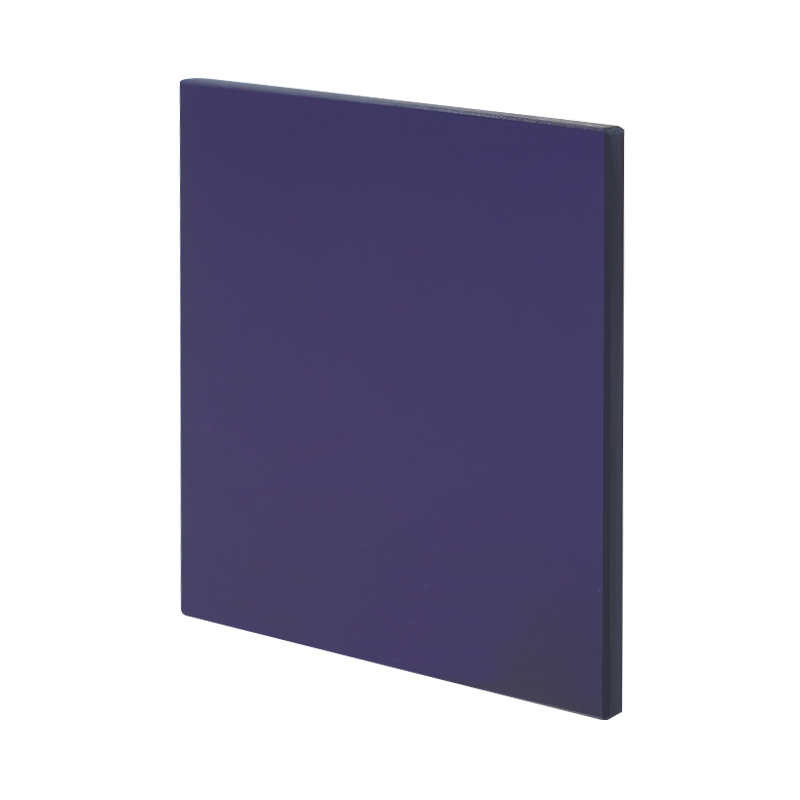
A yellow tone in transmission signals the family that absorbs ultraviolet while passing visible light. Typical uses are UV protection for polymer components, skylight and display windows, and blocking the UV output of lamps before it reaches a sample. Our selective absorption glass filter range lists the standard grades within this group.
Green filters isolate a narrow visible region for lighting and calibration work, while calibration glasses carry stable reference features that spectrometers use to check wavelength accuracy over time. Both are usually bought as small, tightly toleranced parts rather than large sheets.
Neutral density absorption glass
Grey absorbing glass attenuates uniformly across the visible instead of selecting a colour. It is the practical answer for level matching in imaging paths, but it still obeys the thickness rule, so density is quoted at a stated thickness.
Thickness, Batch and Heat: Where Procurement Goes Wrong
Most disputes over absorption filter glass are not about optical design. They are about four practical details.
Thickness referenced to the wrong data. A catalogue curve at 3 mm compared against a price for 1 mm stock will not match, and the lot is rejected for a reason nobody wrote down.
Melt-to-melt variation. Colored glass is a formulation, not a fixed digital value. The cut-on wavelength moves slightly between melts, typically within a stated band; screening to a measured curve costs time and yield.
Edge and surface quality. Rim chips scatter light into the detector path, and a small wedge shifts the effective cut-on across the aperture. Specify chips, parallelism and surface quality together.
Thermal load. Absorbed light becomes heat, and clamping a hot filter rigidly at the rim is a common field failure on lamp-based instruments.
Where the design is dominated by lamp heat rather than spectral purity, a heat-absorbing glass does more useful work than a thin coating: it removes near-infrared energy before it reaches the downstream optics and reduces the thermal load on the rest of the assembly.
A complete enquiry usually gets a usable answer in one round instead of three. Six items carry most of the weight.
Target spectrum with the reference thickness, stated as internal or measured transmittance.
Cut-on or cut-off wavelength and its acceptable tolerance band.
Dimensions, thickness and thickness tolerance, plus parallelism and flatness if the part sits in a converging beam.
Surface quality and edge chip allowance, stated separately.
Source power, beam diameter and mounting method, so thermal load can be checked.
Quantity per year and per release, since screening cost per part changes sharply between ten pieces and ten thousand.
Nantong Xiangyang Optical Element has produced colored and colorless optical glass since 1996, cuts and edges filters to drawing, and works within ISO 9001-2000 and 3C quality systems. A drawing with the six items above is usually enough to confirm whether a standard grade fits or a screened melt is needed.
Frequently Asked Questions
What is an absorption glass filter used for?
It shapes a spectrum broadly: blocking UV or near-infrared light, trimming a red leak, or flattening the response of a silicon sensor. It appears in colorimeters, machine vision lighting, lamp housings and photographic filters.
What is the difference between an absorption filter and an interference filter?
Absorption filters attenuate light inside the bulk glass, so the curve is broad and only mildly angle-dependent. Interference filters use a dielectric coating stack to reach narrow bandwidths and deep blocking, but shift toward shorter wavelengths as the incidence angle grows.
Does glass thickness change the transmission curve?
Yes. Attenuation follows the Beer-Lambert relationship, so doubling thickness roughly squares internal transmittance at each wavelength. Always confirm the reference thickness on a datasheet before comparing suppliers.
Can absorption glass filters block both UV and infrared?
Usually one end at a time. Yellow UV-visible absorbing glass cuts ultraviolet while passing the visible, and cyan-blue glass absorbs red and near-infrared. Deep blocking at both ends generally calls for a different approach.
What tolerance should I expect on the cut-off wavelength?
Standard colored glass melts are commonly specified around plus or minus 10 nm on the cut-off wavelength, with tighter screening available on request. Tighter tolerance means selecting from measured melt data, so plan cost and lead time accordingly.
How do I order a custom absorption glass filter?
Send the target spectrum with its reference thickness, dimensions, thickness tolerance, edge and surface requirements, and source power. The supplier can then recommend a glass family and confirm whether standard stock or a cut-to-order part fits the budget.




 English
 Español