Home · News · Industry News · Why Are Selective Absorption Glass Filters Important for UV Protection?
Why Are Selective Absorption Glass Filters Important for UV Protection?
Author: AdminDate: Mar 12,2026
Selective absorption glass filters are critical for UV protection because they block specific wavelength bands — particularly the 200–400 nm ultraviolet range — while transmitting the visible or infrared light that a system actually needs. Unlike reflective coatings that bounce unwanted radiation away, selective absorption filters absorb the harmful energy within the glass matrix itself, converting it to heat that dissipates harmlessly. This mechanism makes them more stable, angle-insensitive, and reliable across long service lives than surface-coated alternatives. Whether the application is protecting a sensor in scientific instrumentation, shielding an operator in an industrial furnace viewing port, or controlling spectral response in a camera system, the choice of selective absorption glass filter directly determines how much UV energy reaches the downstream component — and how long that component survives.
What Selective Absorption Glass Filters Actually Do
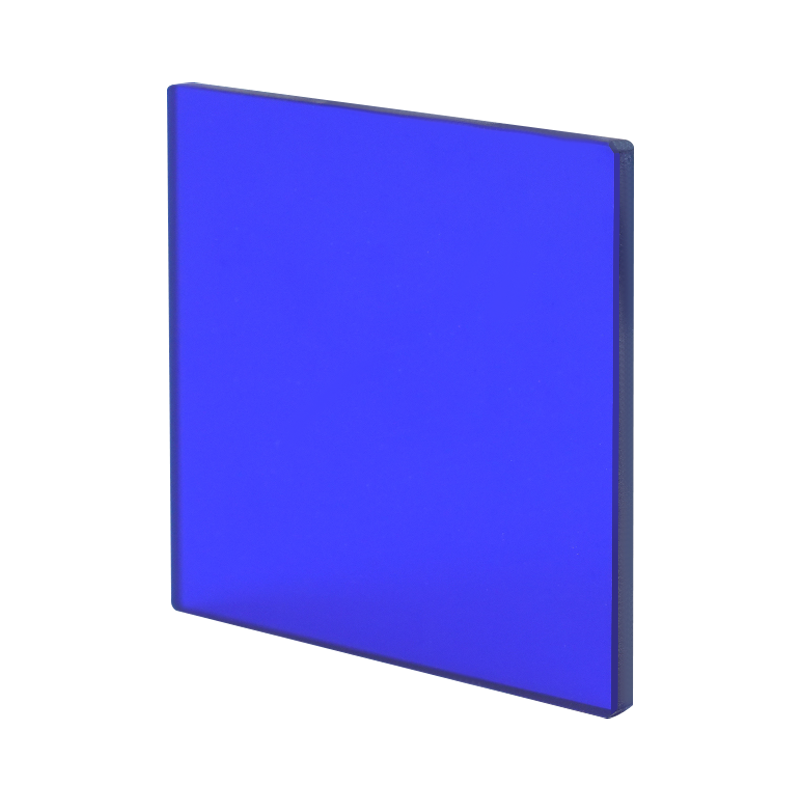
The term selective absorption glass filters describes optical elements manufactured from glass compositions doped with specific metal oxides, rare earth compounds, or colloidal metal particles. Each dopant absorbs photons within a defined wavelength range while remaining transparent elsewhere. The selectivity is determined by the electronic structure of the absorbing species: iron oxide absorbs strongly in the UV and blue-visible range; cerium oxide is a primary UV absorber used in radiation-hardening glass; didymium absorbs the narrow sodium doublet at 589 nm; cobalt blue glass absorbs red and transmits blue.
The absorption occurs volumetrically — photons interact with the dopant atoms throughout the full thickness of the glass, not just at a surface. This gives selective absorption filters several properties that surface-coated interference filters cannot match: the spectral response is independent of the angle of incidence, the filter does not delaminate or scratch to lose performance, and the transmission curve does not shift with temperature changes in the way that thin-film coatings can.
Figure 1 — UV Transmission at 350 nm: Filter Type Comparison
Measured at 350 nm, 3 mm thickness, normal incidence. Selective absorption glass blocks UV volumetrically.
Ultraviolet radiation occupies the 10–400 nm band of the electromagnetic spectrum. For practical optical and industrial applications, the relevant UV sub-bands are UV-A (315–400 nm), UV-B (280–315 nm), and UV-C (100–280 nm). Each sub-band causes different types of damage — and each requires glass with absorption characteristics targeted to that specific range.
UV-A (315–400 nm) — The highest-energy UV band that reaches the earth's surface in significant quantity. Causes polymer degradation, fluorescence in optical cements, retinal damage in direct-viewing applications, and sensor drift in silicon photodetectors. Cerium-doped optical filter glass for UV protection achieves internal transmittance below 0.1% at 380 nm in 3 mm thickness.
UV-B (280–315 nm) — Highly damaging to biological tissue and to many optical coatings and polymer components. Soda-lime float glass blocks most UV-B, but borosilicate and fused silica transmit it freely — making selective absorption dopants essential in those substrate materials.
UV-C (100–280 nm) — Used in germicidal sterilization and semiconductor lithography. In industrial UV sources, protective filters must block UV-C from reaching operators or surrounding materials while allowing visible output light to pass. Iron-doped and cerium-doped glasses are effective absorbers in this range.
The critical insight is that a filter blocking UV-A does not necessarily block UV-B or UV-C — the absorption curve must be matched to the specific threat. An optical filter glass for UV protection designed for camera lens protection (blocking UV-A to prevent haze in digital images) has a very different transmission curve from one designed to protect furnace operators from UV-C generated by arc discharge sources.
Selective Light Absorption Filters for Photography: Controlling Spectral Response
In photography and imaging, selective light absorption filters for photography serve a different but equally specific function: they modify the spectral sensitivity of the imaging system to match the scene, the light source, or the desired creative or technical outcome. Unlike UV-blocking filters used purely for protection, photographic absorption filters shape the entire visible transmission curve.
Common Photographic Absorption Filter Types
UV/Haze filters (UV-absorbing, visible-transmitting) — Block the 300–400 nm band that digital and film sensors register as haze in distant landscape photography. Glass-based UV filters eliminate the slight blue cast that plastic or single-layer coated filters introduce at visible wavelengths.
Yellow, orange, and red contrast filters (for B&W film) — Absorb blue and UV selectively while passing warm wavelengths. A yellow filter absorbing below ~490 nm darkens blue sky and lightens skin tones in monochrome photography. Deep red filters absorbing below ~600 nm produce dramatic sky contrast.
Infrared-pass / visible-cut filters — Absorb all visible light below ~700 nm while transmitting the near-infrared band (700–1,100 nm). Used in IR photography and for converting standard cameras to dedicated infrared imaging systems.
Sodium line suppression (didymium glass) — Absorbs the narrow 589 nm sodium emission doublet. Used in lampworking and glassblowing to eliminate the bright orange sodium flare that obscures the work, and in spectroscopic imaging where sodium contamination would compromise measurements.
Excitation and emission filters for fluorescence imaging — Narrow-band absorption glasses isolate specific excitation wavelengths for fluorescent staining in microscopy and biomedical imaging. Absorption-based filters are preferred over interference types in wide-angle fluorescence setups where angle-dependent shift would degrade isolation.
Table 1: Common Absorption Filter Types for Photography and Imaging Applications
Filter Type
Absorption Band
Transmission Band
Primary Use
UV/Haze (clear)
300–400 nm
400–700 nm (visible)
Digital / film lens protection, haze reduction
Yellow (#8)
<490 nm
490–700 nm
B&W contrast, sky darkening
Red (#25)
<600 nm
600–700 nm
B&W dramatic sky, IR-near photography
IR-pass (720 nm)
<700 nm (full visible)
700–1,100 nm (NIR)
Infrared photography, converted cameras
Didymium
Narrow 585–595 nm
Rest of visible spectrum
Glassworking eyewear, spectroscopy
Infrared Absorption Glass for Industrial Use: Managing Heat in Optical Systems
While UV absorption is the most commonly discussed function of optical filter glass, infrared absorption glass for industrial use addresses an equally critical challenge in high-energy optical systems: managing the thermal load from near-infrared and mid-infrared radiation that carries substantial heat energy but provides no useful imaging information.
In film and digital projectors, the lamp or LED source generates intense near-infrared radiation alongside visible light. Without an infrared-absorbing heat filter, this NIR energy would accumulate in the film gate or the imaging array, causing thermal damage within seconds. Heat-absorbing glass — typically containing iron oxide and other transition metal dopants — absorbs wavelengths above approximately 750 nm while transmitting the 400–700 nm visible band with high efficiency.
Industrial Applications for Infrared Absorption Filters
Furnace and molten metal observation windows — Workers observing high-temperature processes (steel furnaces at 1,400–1,600°C, glass melting tanks at 1,200–1,450°C) require viewing ports that block the intense IR radiation from the melt while transmitting enough visible light to see the process clearly. Cobalt-blue and iron-doped heat-absorbing glasses reduce NIR transmission to below 1% across the 750–2,000 nm range.
Laser line isolation in industrial machine vision — Many machine vision systems use laser illuminators at specific NIR wavelengths (808 nm, 850 nm, 940 nm). IR-pass absorption filters transmit only the laser wavelength band, blocking the ambient visible light that would otherwise overwhelm the camera sensor. This allows reliable part detection in brightly lit factory environments.
Solar simulator heat management — Xenon arc lamps used in solar simulation and weathering test chambers generate a large proportion of their energy in the NIR. Heat-absorbing filter glass placed between the lamp and the test specimen removes this non-solar-spectrum energy, producing a more accurate AM1.5 solar spectrum match for photovoltaic and material weathering testing.
Medical and cosmetic light source filtering — IPL (intense pulsed light) systems and surgical illuminators use absorption filters to deliver precisely defined wavelength bands to tissue. The filter must block both UV (which damages surface tissue) and NIR (which penetrates deeply and generates unwanted heat), transmitting only the therapeutic visible-to-near-IR band for the specific treatment target.
Automotive head-up display (HUD) optics — Windshield glass with selective NIR absorption reduces solar heat gain inside the vehicle while maintaining high visible light transmission. Cerium and iron co-doped glass achieves solar heat gain coefficients (SHGC) below 0.25 while maintaining visible light transmittance above 70%.
How Selective Absorption Compares to Other UV and IR Filtering Technologies
Buyers evaluating UV or IR filter solutions often compare absorption glass against thin-film interference coatings and dichroic reflectors. Each technology has distinct performance characteristics that make it appropriate for specific applications.
Table 2: Absorption Glass vs. Interference Coating vs. Dichroic Reflector — Key Properties
Property
Selective Absorption Glass
Thin-Film Interference Coating
Dichroic Reflector
Angle of incidence sensitivity
None — volumetric absorption
High — spectrum shifts with angle
High — must be used at design angle
Durability / scratch resistance
High — properties in bulk glass
Moderate — coating can be damaged
Moderate — coating-dependent
Thermal stability
Excellent — no shift with temperature
Good, but slight thermal shift possible
Good
Transition band sharpness
Moderate (10–50 nm roll-off)
Excellent (<5 nm edge)
Excellent
Scattered energy
Absorbed (heat) — no back-scatter
Reflected back into system
Reflected to heat dump
Best application
Broadband UV/IR suppression, harsh environments
Narrow-band isolation, laser line filters
High-power lamp systems, projectors
For applications where the filter is exposed to variable angles of illumination, mechanical handling, outdoor environments, or elevated temperatures, selective absorption glass filters consistently outperform coated alternatives in long-term reliability. The trade-off is transition band sharpness — where an interference filter can achieve a cutoff within 2–5 nm, an absorption glass typically rolls off over 20–50 nm. For applications that tolerate this broader transition, absorption glass is the more robust and consistent choice.
Key Specifications to Evaluate When Selecting an Optical Filter Glass
Choosing the correct optical filter glass for UV protection or spectral management requires evaluating several interdependent specifications simultaneously. Optimizing for one parameter often affects others.
Cut-on / cut-off wavelength — The wavelength at which transmission reaches 50% of its peak value. For a UV-blocking filter, this might be specified as "cut-on at 400 nm," meaning the filter begins transmitting visible light at 400 nm and is opaque below that point.
Blocking depth at the target wavelength — Expressed as optical density (OD) or as a percentage. OD 4 means the filter transmits only 0.01% of incident radiation at that wavelength — a factor of 10,000 reduction. For UV protection in direct-viewing applications, OD ≥ 5 (transmission ≤ 0.001%) is commonly required.
Transmission in the pass band — A UV-blocking filter that achieves excellent UV rejection but only transmits 60% of visible light introduces a significant light loss penalty in optical systems. High-quality cerium-doped UV glass maintains visible transmission above 90% at 500 nm while achieving OD > 4 at 350 nm.
Glass thickness — Absorption depth increases with thickness (Beer-Lambert law). Doubling thickness doubles the optical density in the absorption band. Specify both the wavelength-dependent transmission curve and the reference thickness together when comparing filter glass types.
Thermal load capacity — In high-intensity applications (projectors, solar simulators, furnace viewports), the glass absorbs the filtered radiation as heat. The maximum continuous irradiance the glass can tolerate without thermal fracture or degradation must be verified against the source intensity.
Chemical and radiation durability — For outdoor or ionizing radiation environments, cerium-doped glass is specifically formulated to resist solarization (browning under UV or gamma irradiation) that would progressively reduce visible transmission in standard glass compositions.
Interactive: Optical Density & UV Transmission Calculator
Enter the optical density (OD) of the filter at your target UV wavelength to see the resulting transmission and blocking performance.
Transmission Curve Profiles: Understanding What the Graph Tells You
The transmission curve — a plot of percentage transmission versus wavelength — is the primary specification document for any selective absorption glass filter. Understanding what different curve shapes indicate helps engineers and buyers evaluate products correctly.
Figure 2 — Typical Transmission Curves for Common Selective Absorption Filter Types (3 mm thickness)
Indicative transmission profiles — actual values vary by glass composition and manufacturer specification
The didymium curve's sharp absorption notch at 589 nm — while transmitting the rest of the visible spectrum broadly — illustrates the precision achievable with the correct dopant chemistry. The cerium-doped UV filter shows a clean cut-on near 410 nm with high and stable transmission through the visible and near-IR. The heat-absorbing glass achieves high visible transmission but rolls off sharply above 700 nm, providing thermal management without visible light loss.
Frequently Asked Questions
Q1: What is the difference between optical density (OD) and percentage transmission for UV filters?
Optical density is a logarithmic measure of how much a filter blocks radiation at a given wavelength: OD = -log₁₀(T), where T is the fractional transmission. OD 1 = 10% transmission (90% blocked); OD 2 = 1% (99% blocked); OD 3 = 0.1% (99.9% blocked); OD 4 = 0.01% (99.99% blocked). Percentage transmission is more intuitive but OD is preferred in technical specifications because it scales linearly with the logarithm of blocking power — additive filter stacking in OD corresponds directly to multiplying the blocking effect.
Q2: Can selective absorption glass filters be combined with anti-reflection coatings?
Yes, and this is common practice in precision optical systems. The absorption glass provides the spectral filtering function volumetrically, while an anti-reflection (AR) coating on the polished surfaces reduces the 4–8% per-surface Fresnel reflection loss that would otherwise reduce overall system throughput. The two functions are independent: the AR coating does not affect the absorption spectrum, and the absorption glass does not affect how the AR coating reflects light at the surfaces. For high-transmission applications in the pass band, specify both an absorption glass grade and surface AR coating appropriate to the pass wavelength range.
Q3: How does glass thickness affect UV blocking performance in selective absorption filters?
Absorption follows the Beer-Lambert law: increasing thickness increases optical density proportionally. If a 3 mm thick glass achieves OD 3.0 at 350 nm, a 6 mm piece of the same glass achieves OD 6.0 at 350 nm — a 10,000× improvement in blocking with a doubling of thickness. However, increasing thickness also increases absorption in the pass band by the same mechanism, slightly reducing visible transmission. The practical implication: when deep UV blocking is required, thicker glass or a more heavily doped glass formulation must be specified, and the resulting visible pass-band transmission must be recalculated for the new thickness.
Q4: Are selective absorption glass filters affected by prolonged UV exposure (solarization)?
Standard optical glass can develop solarization — a progressive browning or yellowing under intense UV or ionizing radiation exposure — caused by the formation of color centers in the glass structure. For applications involving continuous UV exposure (solar simulators, germicidal lamp housings, outdoor measurement systems), cerium-doped glass formulations are specifically designed to resist solarization. The cerium ions absorb UV energy and then return to their ground state without forming stable color centers. Radiation-hardened cerium glass maintains stable visible transmission even after accumulated UV doses that would significantly degrade standard soda-lime or borosilicate glass.




 English
 Español